
Superman arrived in 1938. The word superfood had already been circulating for more than twenty years. This seems unfair. Superman had to come from another planet, lift cars and stop bullets. The banana merely hired an advertising agency.
The word superfood was not born in a laboratory. No scientist looked into a microscope and cried, “Good heavens, this fruit has a cape!” One of its earliest great publicity vehicles was the banana. In the early twentieth century, the United Fruit Company wanted Americans to eat more of the tropical fruit it imported. Bananas were promoted as inexpensive, nutritious, convenient, digestible and naturally wrapped. The world’s first celebrity superfood came in yellow packaging.
Behind that cheerful fruit stood plantations, ships, railways and an immense machinery of commerce. The banana’s rise was not simply a nutritional success; it showed that appetite could be manufactured, and that food sold better when commerce spoke in the language of health.
Medicine then accidentally gave marketing a stethoscope. In 1924, American paediatrician Sidney Haas published his results using a banana-heavy diet for children with coeliac disease. Many improved largely because the restrictive diet happened to exclude wheat, and therefore gluten, whose role in coeliac disease was not yet understood. The banana received the applause for a crime it had merely failed to commit. It was like switching off a faulty ceiling fan and thanking the chair on which you stood.
A century later, a patient placed a small packet on my table.
“Doctor, I have started superfood.”
“What is inside?”
“Imported berries. Antioxidants.”
“What will they do?”
“Immunity, heart, brain, liver. Everything.”
“How much?”
“₹850. But health is important, doctor.”
Breakfast was tea and biscuits. Dinner came at 10.45 p.m. on a motorcycle. He slept five hours and walked mainly when the lift was under repair.
“Why not correct these things first?” I asked.
He gave me the most intelligent answer in the room. “Changing the whole lifestyle is difficult, doctor. This packet is easy.” There was the entire industry, sitting between us.
The superfood business does not merely sell nutrition. It sells absolution. One spoon will pardon the missed breakfast, the sedentary day, the midnight biryani and the gym membership last used during the free trial. Discipline is slow, repetitive and invisible. You can buy a packet in thirty seconds and photograph it immediately.
Scientifically, however, superfood means almost nothing. No universally accepted definition, no qualifying nutrient score, and no committee promoting kale while brinjal waits outside. Under European rules, health claims used in food marketing must meet regulated conditions; broad claims must be accompanied by an authorised specific claim. A food may be rich in fibre, protein, minerals or plant compounds. That makes it valuable. It does not make it able to negotiate privately with your pancreas.
The exaggeration often begins innocently. A scientist reports that a compound modestly altered one biological marker in selected mice. By the time the finding reaches social media, modestly has disappeared, the mice have become all humanity, and the marker has become immortality. Lowering a laboratory number is not the same as preventing a heart attack. A substance that behaves magnificently in a test tube may be poorly absorbed, rapidly broken down or impossible to obtain from normal portions. A human being is not a test tube with an Aadhaar card.
Sometimes science delivers a more uncomfortable surprise. Diets containing fruits and vegetables rich in beta-carotene appeared beneficial, so researchers tested beta-carotene supplements. In a major trial involving 29,133 Finnish male smokers, taking 20 milligrams of beta-carotene daily for five to eight years did not prevent lung cancer; it was associated with an 18 per cent higher incidence.
The lesson was not that carrots had become dangerous. It was that extracting one celebrated compound from food, concentrating it and swallowing it as a hero could produce a different story. The orchestra had been dismissed. One violin was handed an amplifier.
Nutrition science is difficult because food never travels alone. A person who regularly eats blueberries may also exercise, smoke less, sleep better and have easier access to healthcare. The berry sometimes receives credit for the life surrounding it. Food itself arrives as a structure of fibre, water, protein, fat and thousands of interacting substances. This food matrix can influence digestion and absorption. The intestine reads the entire book. Marketing underlines one sentence and sells it separately.
India has added its own magnificent comedy. We send familiar foods abroad and welcome them home after they improve their English. Ragi becomes finger millet. Drumstick leaves become moringa. Haldi travels overseas, enters a golden latte and returns with an American accent. Sabja had been swelling peacefully inside falooda long before chia obtained a passport.
But beneath the comedy sits aspiration. In many parts of India, millets became associated with drought, rural hardship, and modest kitchens. As agricultural policy, public distribution and consumer preference increasingly favoured rice and wheat, many households moved away from coarse cereals. Now those neglected grains have returned through dietitians, cafés and premium brands. A food eaten by a labourer was called necessity. The same food served in a ceramic bowl under a hanging lamp became wellness. Its nutrients did not change. Its social address did.
Commercial estimates of this market vary because no one agrees on what belongs in the category. One market-research company, using its own broad definition, valued India’s superfoods market at about US$6.4 billion in 2025 and projects that it may more than double by 2034. The figure is an industry estimate, not an official statistic. The direction, however, is believable. Rising incomes, lifestyle diseases, post-COVID anxiety, time poverty and social media have created the perfect customer: informed enough to worry, busy enough to seek shortcuts and prosperous enough to purchase them.
A packet also sells identity. Chia in a glass says, “I am disciplined.” Quinoa says, “I read labels.” A green powder says, “I have taken charge of my health,” even if it is swallowed while answering office messages at midnight. Wellness has made the intention publicly visible and the habit privately optional.
Marketing is not entirely the villain. It has revived interest in neglected grains, seeds, greens and fermented foods. Done responsibly, renewed demand may encourage crop diversity and create opportunities for farmers. Convenience also matters. A working mother is not morally inferior for choosing a packaged, nutritious breakfast on a chaotic morning. Marketing can rescue a forgotten food. The trouble begins when rescue becomes coronation.
Amla, sesame, millets, berries and nuts can all improve a diet. But a millet biscuit remains a biscuit. Ancient grain cannot cancel modern sugar. Honey in a dessert does not frighten glucose molecules merely because a bee has participated. Adding almonds after pakoda is not substitution. It is a second snack with better public relations.
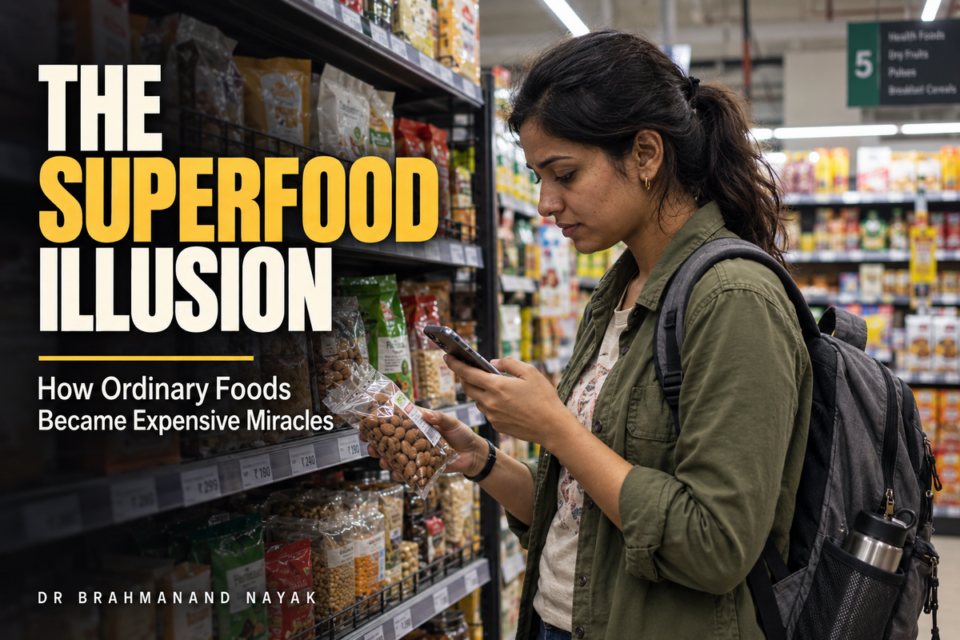
In the supermarket, ignore the mountain, the green leaf and the woman doing yoga at sunrise. Turn the packet around. If sugar and refined flour appear before the celebrated millet, the front is literature; the back is evidence. Ask what the product will replace, how much you will eat and whether you can afford it often enough for it to matter. Health is shaped less by the noblest ingredient in the cupboard than by the ordinary meal repeated on tired Tuesdays.
The strongest evidence in nutrition still belongs to patterns: vegetables, fruits, pulses, suitable whole grains, nuts, seeds, adequate protein, sensible portions and fewer ultra-processed foods. A varied, fibre-rich diet supplies different substrates to the gut microbiome. Muscles prefer use. Sleep cannot be powdered. No seed, however ancient, can outvote an entire life.
My patient picked up his ₹850 packet.
“Should I stop it, doctor?”
“No. Eat the berries if you enjoy them.”
“And for my health?”
“Eat breakfast. Walk after dinner. Sleep before tomorrow begins.”
He nodded. The advice was cheaper than the berries, which made it harder to believe.
He left with the packet.
The banana stayed on my table. By evening, one brown spot had appeared on its skin.

1 comment
Nice article ! Well explained about the hype of superfoods and and what actually is necessary for good health.