
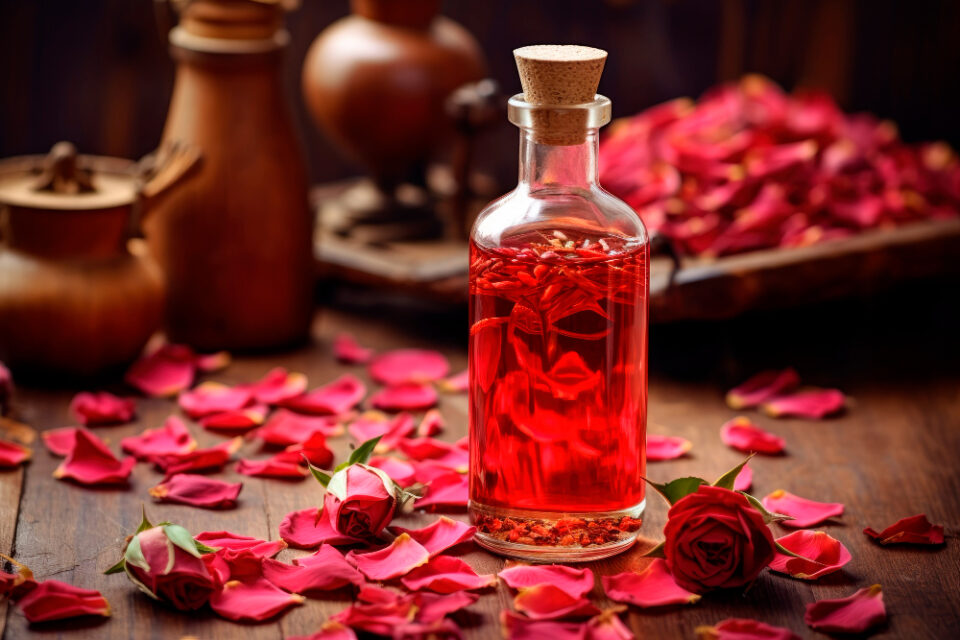
A lady walked into my clinic one sweltering April afternoon, opened her handbag with the seriousness of a surgeon preparing for an operation and placed a small bottle of rose water on my table. “Doctor, can I use this?”
“For what?” I asked. She looked at me with genuine concern.
“For everything!”
Acne. Pimples. Dark circles. Dry skin. Burning eyes. Face packs. Summer heat. Even her daughter-in-law’s wedding make-up.
In nearly three decades of medical practice, I have prescribed medicines that work for one illness, a few that help several, and some that pleasantly surprise us. But only rose water has been promoted by the public into a dermatologist, beautician, ophthalmologist, chef, perfumer and counsellor—all inside the same little bottle. If household products had LinkedIn profiles, rose water would proudly display ten job titles and still be looking for new opportunities.
The truth, however, is far more fascinating than the myth.
Rose water has survived for centuries not because it performs miracles, but because it quietly does a handful of simple things remarkably well. Somewhere between grandmother’s dressing table and today’s social media reels, we promoted a fragrant helper into a universal healer. That says less about the rose than about human nature. We are irresistibly attracted to remedies that are inexpensive, pleasant, familiar and available in the neighbourhood shop.
The first surprise comes before the bottle is even born. Genuine rose water is not prepared by soaking petals in water overnight. It is created through steam distillation. Fresh rose petals are gently heated, allowing steam to carry delicate aromatic compounds away from the flower. As the fragrant steam cools, it separates into two products. The precious essential oil floats above. Rose water remains below. One becomes among the world’s most expensive essential oils. The other enters ordinary Indian homes without announcing its remarkable journey.
There is another reason genuine rose products command respect. Producing rose essential oil is astonishingly labour-intensive. Depending on the variety and oil yield, several tonnes of fresh rose petals may be required to produce just one kilogram of rose oil. Rose water is fortunately much more affordable because it contains only a small fraction of these aromatic compounds. The next time someone wonders why genuine rose products are expensive, remember that the bottle once began life as a field full of flowers.
Even the flower refuses to cooperate with lazy people. The Damask rose, the variety most widely used for distillation, is harvested before sunrise. As the morning grows warmer, some of its delicate, volatile compounds begin to escape into the atmosphere. Farmers understood this long before chemists explained it in laboratories. Roses, it seems, finish half a day’s work before many software engineers have opened their laptops. Every bottle of genuine rose water therefore begins its life while most of the city is still asleep.
Now comes the practical question patients ask me most often.
Doctor, which rose water should I buy?
My answer is always the same. Ignore the photograph of the flower on the front label. Marketing departments usually employ more roses than farms do. Turn the bottle around and read the ingredients. Look for steam-distilled rose water or rose hydrosol. Fewer ingredients are generally better. If the ingredient list begins with water, synthetic fragrance, colour and several preservatives but says very little about distilled rose water, be cautious. Genuine rose water is usually clear rather than bright pink. And if you intend to use it in desserts or drinks, make sure the bottle is clearly labelled as food-grade. Cosmetic products belong on the dressing table, not inside your kheer.
A college student once returned to my clinic with worsening acne. She had stopped the treatment prescribed by her dermatologist after watching an online video claiming that rose water alone would clear pimples within two weeks. The video gathered millions of views. Her pimples gathered a few more friends. Rose water can certainly refresh the skin, particularly during hot Indian summers. Refrigerated, it feels wonderfully soothing after cleansing the face. But refreshing and treating are not the same thing. It does not cure acne, erase pigmentation, permanently tighten pores, or reverse ageing. Healthy skin still depends upon good sleep, sun protection, appropriate skincare and, when necessary, proper medical treatment. Home remedies are wonderful companions. They become poor substitutes when asked to replace science.
The commonest misuse I encounter, however, concerns the eyes.
Doctor, my eyes are burning. Shall I put rose water?
Please don’t.
Ordinary cosmetic or culinary rose water is not manufactured as an eye drop. The eye demands sterility, not sentiment. If you have redness, pain, discharge or blurred vision, consult an ophthalmologist instead of experimenting. After long hours at a computer, a clean, cool compress gently placed over closed eyelids may provide comfort. But let the rose remain outside the eye. It already has enough jobs.
Many people also tell me that the fragrance of rose water instantly relaxes them. Interestingly, science offers a possible explanation. Among all our senses, smell has one of the shortest routes to the brain’s emotional and memory centres. Before your thinking brain finishes asking, “What is this fragrance?”, another part quietly replies, “I have met this before.” That is why the aroma of roses can unexpectedly remind us of a grandmother’s courtyard, a childhood festival or a long-forgotten summer evening. Research on Rosa damascena suggests that its aroma may promote relaxation in certain situations, although it should never be mistaken for treatment of anxiety or depression.
Classical Ayurvedic texts describe the rose, Śatapatra, as pleasant and cooling. Ayurveda gave the rose respect, not superstition. It was one useful flower among many, never the hero of every illness. Somewhere along the centuries, our imagination became far more ambitious than the classical texts ever were.
If there is one place where rose water deserves a permanent invitation, it is the kitchen. A teaspoon added to kheer, phirni, shrikhand, falooda, lassi or certain Indian sweets lends an aroma that is noticed without announcing itself. The secret is restraint. Too little and nobody notices. Too much and dessert tastes as though it has wandered into a perfume shop. Good cooking and good prescribing follow the same principle. The right dose is often more important than the ingredient.
Finally, store the bottle tightly closed and away from heat and direct sunlight. Refrigerate it after opening if the manufacturer recommends it. Discard it if the smell changes unusually, the liquid becomes cloudy, or contamination is suspected. If you have sensitive skin, perform a small patch test before regular use. “Natural” simply describes where something comes from. It does not guarantee safety. Nature manufactures both roses and poison ivy with equal sincerity.
Every generation seems to have its miracle bottle. Yesterday it was rose water. Today it may be collagen serum. Tomorrow it will probably arrive in a beautifully designed bottle with an even more beautiful advertisement. The bottle changes. Human hope does not. Rose water has survived every fashion because it never needed impossible promises. It offered a little fragrance, a little freshness and a little comfort and allowed centuries to judge its worth. That is its greatest lesson. The remedies that endure are rarely the loudest. They are simply the ones who continue to do a few ordinary things exceptionally well.
