
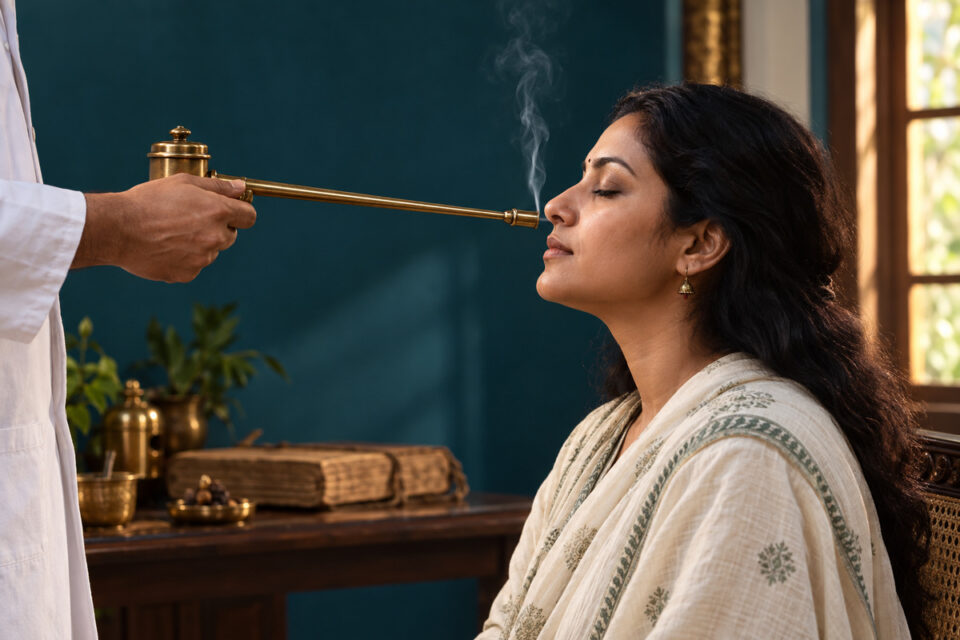
The first time a patient’s wife walked into my clinic holding her husband by the collar, I assumed the emergency belonged to him. It did not.
Doctor, he has started smoking again. Secretly. Behind the water tank. I can smell it on his kurta.” The husband straightened his collar with the wounded dignity of an innocent man. “Doctor told me to do dhuma. Ask him.”I had mentioned Dhumapana while explaining an Ayurvedic procedure. He remembered one Sanskrit word, forgot every instruction around it, and turned half a sentence into medical permission. At the time, I thought the misunderstanding belonged entirely to him.
In 2026, it appears he was merely ahead of the trend. In August, actor and travel influencer Shenaz Treasury posted a video of herself receiving Dhumapana at an Ayurvedic retreat in Kerala. The image was irresistible: a woman apparently smoking inside a place devoted to health.
Then came a more theatrical demonstration. Baba Ramdev sat before a brass hookah, combined ingredients including mulethi, turmeric, mustard, ghee, camphor and kakra singi, and presented the smoke for cough and nasal congestion. The clips travelled widely. Dhumapana, which had spent centuries in medical texts and decades inside quiet Ayurvedic wards, suddenly acquired what every ancient therapy now apparently requires: a camera angle.
The curiosity is understandable. Smoke has become synonymous with addiction, cancer and warning labels. To see it administered in a clinic produces immediate disbelief. Is Ayurveda really prescribing smoking? The short answer is no. The longer answer is where the medicine begins. Dhumapana is the controlled administration of smoke generated from a prescribed medicinal preparation.
Traditionally, a herbal wick called a Dhumavarti is placed inside a specially designed pipe called a Dhumanetra. The patient takes a few measured inhalations through the route chosen for the condition and expels the smoke through the mouth. The procedure may be over before an ordinary smoker has properly settled into his first cigarette. There is no leisurely puffing. The smoke is not meant to be drawn deeply into the chest and held there. One does not continue until the wick is exhausted. A cigarette is designed to continue. Dhumapana is designed to stop at a prescribed point.
The difference lies not merely in what is burnt but in everything surrounding it: the patient, the condition, the preparation, its strength, the timing, the instrument, the route and the signs that tell the physician to stop. Asking whether Dhumapana is beneficial is rather like asking whether an injection is beneficial. What is inside it? Who needs it? How much? For what purpose? Given by whom? Remove those questions and very little remains except burning plant material.
What surprises me, returning to the classical chapters after thirty years in practice, is not that the ancient physicians used smoke. Medicine has always employed substances capable of helping in one dose and harming in another. What surprises me is how little they trusted Dhumapana without rules. Charaka distinguished mild, lubricating and stronger eliminative forms. Different preparations were intended for different patients and purposes. The texts specified when the procedure could be administered, how the patient should sit, how the smoke should enter, how it should leave and who should not receive it. They also described the signs of proper administration and the symptoms of excess. The treatment occupied a few breaths.
The precautions occupied considerably more space. Even the pipe received an engineer’s attention. Classical descriptions prescribe different lengths of dhumanetras for different preparations. The smoke therefore travelled through a long, narrow passage before reaching the patient. It is reasonable to infer that the distance reduced some of its heat and harshness. The instrument itself appears to embody a medical idea: before a potent substance reaches the body, its violence must be moderated.
The direction of the smoke mattered too. Smoke taken through the nose was to be expelled through the mouth, not driven back through the nostrils. The classical warnings about improper exhalation are severe, including possible eye injury. We need not force every ancient explanation into modern anatomy to recognise the underlying intelligence. This was never “light it and see.”The texts make claims that may surprise even Ayurvedic physicians. Charaka associates properly administered Dhumapana not only with relief from excessive secretions and heaviness of the head but also with protection of the voice, teeth, sense organs and hair. These are classical claims, not promises a modern physician should transfer unquestioned onto a clinic board. Yet they reveal how closely the older physicians connected the nose, mouth, eyes, scalp and throat.
Dhumapana was also placed at particular moments in a daily or therapeutic sequence—after procedures such as tooth-cleaning, Nasya or collyrium, depending on the preparation and purpose. It was rarely imagined as a solitary remedy. It was one carefully positioned step within a larger treatment.
That remains the crucial distinction in practice. Two people may arrive using the same word—“sinus”—and require opposite decisions. One has thick discharge, heaviness and a coated voice, as though his forehead has been rented to kapha. Another has dry, raw nasal passages, burning and occasional bleeding. A carefully selected Dhumapana might be considered for the first. In the second, smoke could aggravate precisely what is already suffering.
During the procedure, the physician watches the patient more closely than the smoke. Is the heaviness receding, or is the mucosa merely becoming irritated? Has the voice cleared? Are the eyes watering excessively? Has coughing increased? Patients sometimes assume that a stronger sensation means a stronger cure. But a burning throat is not proof that medicine is working. It may simply be the body withdrawing its consent. That is how Ayurvedic physicians use Dhumapana: occasionally by administering it, often by modifying it and frequently by deciding not to use it.
The controversy has arrived at a moment when another kind of herbal smoking is expanding. Tobacco-free cigarettes containing basil, clove, mint, cinnamon and other plants are increasingly marketed as cleaner or more natural alternatives. The language performs a small trick. “Nicotine-free” quietly becomes “harmless” in the consumer’s mind, though the two expressions mean entirely different things.
In May 2026, researchers from IIT Gandhinagar and the University of Illinois Urbana-Champaign compared emissions from commercial herbal and tobacco cigarettes. Some herbal variants emitted ultrafine particles at concentrations comparable to or higher than tobacco cigarettes. Tendu-leaf-wrapped products showed particularly high oxidative potential, a measure of particles’ capacity to provoke harmful biological reactions. One supposedly natural product also produced the highest lead concentration among the samples examined. The study did not test classical Dhumapana, and it would be dishonest to suggest that it did. But it demolished one comforting assumption: burning herbs does not automatically produce safe smoke. Journal of Hazardous Materials study
That distinction must be preserved in both directions. A commercial herbal cigarette is not classical Dhumapana. But Dhumapana cannot claim exemption from the chemistry of combustion merely because it is classical. Medicinal plants may contain useful volatile compounds; burning them may also generate irritants and fine particles. Both can be true.
The limited clinical studies available offer questions worth pursuing, not permission for extravagant claims. Statements about “eight times less tar,” “no carcinogens”, or dramatic improvements in lung function should not be converted into certificates of safety without examining the formulation, sample size, controls, analytical methods and independent replication. Less harmful than a cigarette is not another way of saying harmless. Science, like Ayurveda, begins by asking exactly what was measured. The real problem, then, is not that an ancient procedure appeared on social media. Traditions should be discussed, demonstrated and investigated. The problem is that the camera showed the smoke but could not show the physician.
A procedure is not defined by its most visible act. Surgery is not cutting. Vamana is not vomiting. Nasya is not pouring oil into the nose. Dhumapana is not smoking. Each becomes medicine through everything outside the camera’s frame: whom to select, what to administer, how much to give, when to stop and what to do when the body objects. Social media preserves the spectacle and removes the judgement. Unfortunately, the judgement was the treatment.
I told him plainly: what he had been doing behind the water tank was not Dhumapana. It was smoking. His wife released his collar, but not her suspicion. At the door, she turned back.
Doctor, if it needs so much explanation, why do they show it in thirty seconds?”

1 comment
Nice article sir