
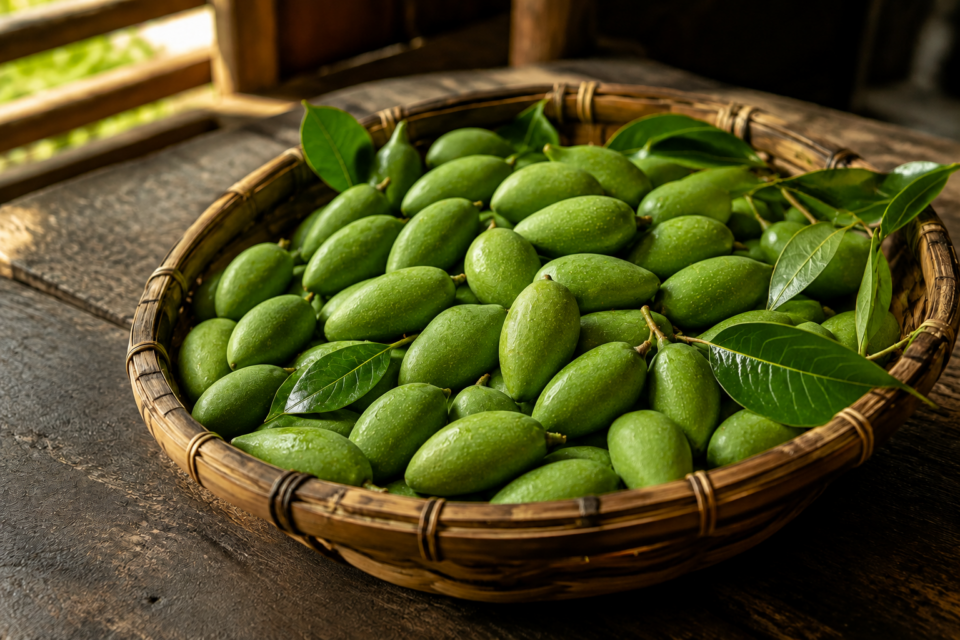
Every mango is expected to ripen, soften and become sweet. Appemidi refuses. This small, intensely sour mango from Karnataka’s Western Ghats is picked while it is still green and hard. It never reaches a fruit bowl. Nobody makes a milkshake from it. It goes straight into salt. That is where its real life begins.
In the coastal and forest districts of Karnataka, the appemidi season was once passed down by word of mouth. Someone had found fruit on an old tree beside a river. A farmer was ready to harvest. A relative was travelling from Gokarna to Bengaluru. Within hours, sacks were reserved, jars washed and family members assigned duties. No other mango created so much work and remained so warmly welcomed.
For readers outside Karnataka, appemidi—also spelt appe midi—is not a single standard variety like Alphonso or Kesar. Midi means a tender, unripe mango in Kannada. Appemidi is a large family of local mango types prized for pickling. Some are round. Some are slender. Some curve at the tip. Their acidity, fragrance and firmness can change from one tree to the next.
Their names carry pieces of local history. Ananta Bhattana Appe remembers a person. Jeerige Midi is associated with a cumin-like aroma. Other types are named after villages, families, shapes or scents. Long before laboratories arrived, local women identified the finest trees by smelling the sap, biting the fruit and watching what happened in brine. The nose was the first research instrument. It needed neither electricity nor a research grant.
Researchers examining Western Ghats appemidi types found remarkable genetic variation and identified more than eighty volatile compounds. Much of their fragrance comes from distinctive combinations of terpenes—tiny aroma molecules that escape into the air. This explains why opening one bottle can announce lunch in three rooms and wake an uncle who had claimed not to be hungry.
Fragrance alone is not enough. A superior appemidi must remain firm after months in salt and spices. An ordinary tender mango may soften, wrinkle or lose heart. A good appemidi absorbs everything and retains its bite. It can spend a year crowded inside a bottle without losing its identity, a degree of emotional stability not always seen among those eating it.
The method may be traditional, but the science is exact. Salt draws water from fruit, making it difficult for many organisms that spoil food to thrive. Natural acidity adds protection. When used, oil reduces exposure to air. Dry containers and spoons prevent unwanted moisture. One wet spoon can undo weeks of labour and remain a topic of family investigation longer than the pickle itself.
Every household has its own method. One adds mustard. Another trusts fenugreek. Some use sesame oil; others begin with nothing but salt and spices. Measurements are rarely written down. Salt is “this much.” Chilli is “as required.” Mustard is added until the ancestors appear satisfied. The recipe is perfectly clear to everyone except the person attempting to follow it.
The tree matters as much as the recipe. Many prized appemidi trees grow beside rivers, farms and forest edges rather than in obedient orchards. Families know them individually. This one gives the strongest fragrance. That one produces the firmest fruit. Another is so sour that one bite closes both eyes, tightens the scalp and introduces the mouth to salivary glands it had forgotten.
Along a ten-kilometre stretch of the Aghanashini River, recent documentation has recorded more than a thousand naturally occurring appemidi trees. Local communities have recognised over a hundred distinct types. Each tree carries its own combination of shape, flavour and fragrance. The Aghanashini is therefore not merely a river flowing towards the Arabian Sea. It is a mango library growing along both banks.
Appemidi has also received official Geographical Indication registration, recognising its bond with Karnataka. But a certificate cannot protect a tree from an axe, an altered riverbank or old age. Conservationists are now seeking stronger protection for the Aghanashini region. A rare mango saved only on paper is much like a pickle recipe preserved after the last tree has disappeared—accurate, respectable and useless. Its scarcity has created another problem. An earlier horticultural estimate put Karnataka’s annual pickle demand at 4,000–5,000 tonnes, while genuine appemidi reportedly met only a fraction of that demand. Ordinary tender mangoes are therefore sometimes mixed with or sold as appemidi. Even in the mango world, a famous star eventually acquires understudies, duplicate costumes and an imaginative publicity department.
This diversity is not merely culinary decoration. Different trees carry different genes for acidity, aroma, keeping quality, disease response and adaptation to local weather. Those traits may help plant breeders face pests or climatic changes that have not yet arrived. When one unique tree dies without being grafted or conserved, its exact qualities may disappear with it. Forests do not provide backup copies.
As a physician, I must add one less romantic fact. Appemidi pickle can brighten the plainest meal, but ancestral salt remains salt. People with uncontrolled hypertension, kidney disease or prescribed fluid and sodium restrictions should eat it sparingly. It is a condiment, not a vegetable serving. Heritage may deserve a generous place in the heart; on the plate, one exquisite piece is enough.
Months later, someone opens a bottle in Bengaluru, Mumbai, Melbourne or a home far from Karnataka. The fragrance escapes before the spoon enters. Suddenly there is an old tree beside a river, a summer afternoon and a kitchen crowded with green mangoes. Appemidi was never meant for dessert. Sweet mangoes finish a meal. This one brings back a place.
