
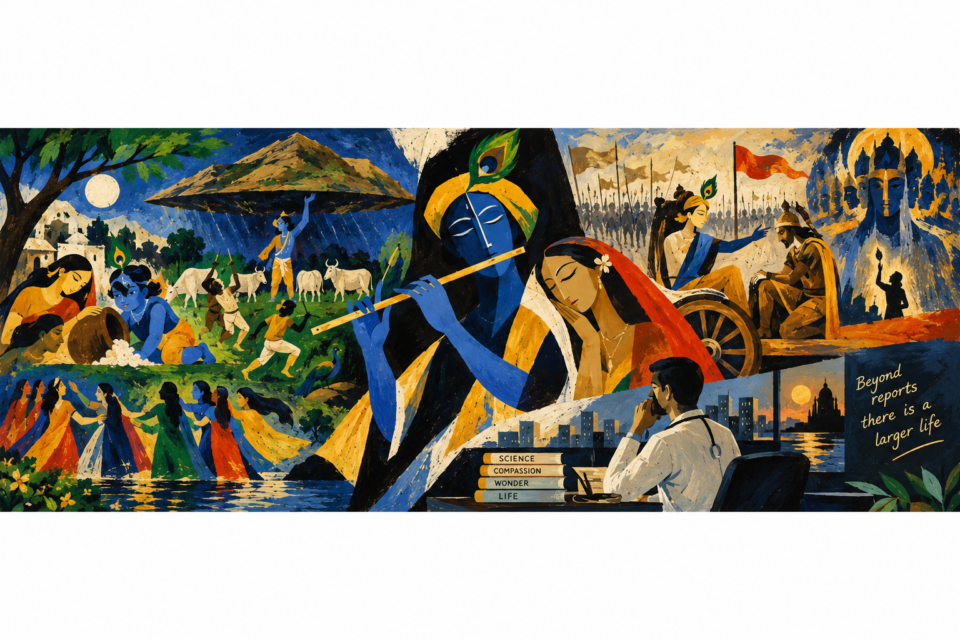
If Lord Krishna were born in Bengaluru tonight, I suspect the first serious difficulty would not be Kamsa. It would be advice. Before Vasudeva reached the Yamuna, somebody would have forwarded him a WhatsApp message warning against carrying a newborn in the rain. Yashoda would be told to avoid butter. Someone would recommend vitamin D because the child was born at midnight. His sleep would be tracked, his butter labelled saturated fat, his flute converted into a breathing exercise, and by the time he lifted Govardhana, an orthopaedic opinion would probably have been arranged.
We live in the golden age of advice. Nothing may simply be eaten, enjoyed or celebrated anymore. It must be measured, optimised and preferably turned into a health tip. I say this with amusement but also with reverence. I am a devotee of Krishna. I have been chanting the Vishnu Sahasranama for decades, and Krishna belongs to that private interior landscape where medicine, memory, prayer and the unanswered questions of life sometimes meet.
I have no desire to prove that Krishna “knew neuroscience” or that the Bhagavad Gita predicted modern medicine. Such claims diminish both science and scripture. Krishna does not need validation from a laboratory. It is the laboratory that, after nearly three decades of medical practice, has sometimes made me look at Krishna differently.
For most of my adult life, I have sat on one side of a consulting table. I have palpated thousands of pulses, examined tongues, read scans, discussed bowel movements with managing directors, explained cholesterol to grandmothers, and repeatedly informed perfectly intelligent people that jaggery has not received divine exemption from being sugar. During those years the reports have become longer, the machines cleverer and patients astonishingly fluent in numbers.
Many now know their HbA1c, LDL, vitamin D, TSH, and uric acid to almost the decimal place. Some know yesterday’s step count, resting heart rate and exactly how many minutes their watch believes they slept deeply. This is progress. Numbers save lives. I have no nostalgia for the days when hypertension sometimes waited for a stroke to introduce itself.
Yet the longer I practise, the more interested I become in what never appears on the report. Does this person still laugh easily? Does she have someone she can call when frightened? When did he last eat without looking at a screen? Does music still move her? Can he tolerate an empty hour? Is there anything in her week done for no reason except delight? I have privately begun to think of these questions as another line of inquiry.
The Krishna Test.
It requires no fasting, costs nothing and cannot be ordered from a laboratory. A person can have magnificent blood test results and still fail it. Janmashtami makes me think about this because Krishna’s world is full of things we have gradually pushed out of ordinary life and are now laboriously prescribing back to ourselves. We removed walking and invented the treadmill. We filled every silent minute and downloaded meditation apps. We became permanently connected and then discovered loneliness as a health problem.
Modernity has a remarkable business model: first remove something free, then return it with a subscription. Janmashtami itself begins at midnight, when our biology expects something very different from celebration. Human physiology runs on rhythms. A master circadian clock in the brain helps coordinate clocks throughout the body; light, sleep, activity and meal timing help keep this orchestra together. Even glucose handling changes with biological time. We call it “the body clock,” as though there were one clock above reception. The body is closer to a watch shop.
That is worth remembering when the midnight prasada arrives. For someone with diabetes, a little prasada is devotion. Four pooris, potato curry, payasam and three laddus are not devotion multiplied by ten. The pancreas is a hardworking organ, but it has not read the festival calendar. Then comes butter. Krishna’s makhan interests me less as fat than as food history. Traditional butter emerged through a sequence—milk, curd, fermentation, churning, butter, buttermilk. What looked like Yashoda doing ordinary kitchen work involved microbes, acids, proteins and fat globules performing remarkably sophisticated chemistry. Yashoda simply neglected to call it artisanal cultured dairy and charge ₹450 for a small jar.
There is a larger point here. Modern nutrition increasingly recognises that food is not merely the arithmetic total of carbohydrate, protein and fat; structure and processing matter too. Ayurveda, in its own distinct framework, also did not treat milk, curd, butter, buttermilk, and ghee as interchangeable substances. Somewhere along the way we became fond of reducing experiences to numbers. Food became nutrients. Walking became steps. Sleep became a score. Friendship became followers. Health became a dashboard. The dashboard is useful. But I have met enough patients to know that it is possible to have a beautiful dashboard and a miserable journey.
Then Krishna picks up his flute. Of everything in this essay, the flute stays with me most. Not because of its notes, but because of its emptiness. A flute works because it is hollow. Fill that empty interior, and you do not improve the instrument. You destroy the music.We, meanwhile, have declared war on empty space. Twenty seconds at a traffic signal and the phone comes out. Forty seconds in a lift and the phone comes out. Five minutes before the next patient and my own hand knows exactly where the phone is. We walk with podcasts, eat with videos and go to bed intending one final scroll, an expression that has probably caused more insomnia than coffee. We fill every hollow and wonder where the music went.
The flute also turns breath into sound. Breathing is unusual: it runs automatically, yet we can consciously change it. Research on slow breathing shows measurable effects on cardiorespiratory and autonomic function. But I do not need to claim that Krishna was stimulating his vagus nerve beside the Yamuna. We have no ECG from Vrindavan, and I hope nobody produces one on WhatsApp. The older image is better. India imagined serenity as someone whose breath had become music.
After years of listening to patients, I have come to value the hollow spaces too. Conversation needs pauses. Sleep needs darkness. Prayer needs silence. Creativity often needs boredom. A life packed completely with useful things can become strangely useless to the person living it. Perhaps emptiness is not always something missing. Sometimes it is the space through which music becomes possible.
And Krishna plays. This may be his most radical quality in our age of productivity. Lila is philosophically far richer than the English word “play,” and I would never reduce it to a health hack. But Krishna’s playfulness asks a wonderfully inconvenient question: must everything have a purpose? We walk to lose weight, read to improve ourselves, meditate to reduce cortisol and travel partly to prove that we travelled. Hobbies become side businesses. Sleep earns scores. Rest itself has become work.
Children have not yet learned this madness. A puddle can stop them. An ant can bring three children to their knees. A cardboard box can defeat the expensive toy inside it. Then adulthood arrives. We sit at breakfast, sit in a vehicle, sit at work, sit on the journey home and sit again after reaching home. Eventually, a doctor tells us that prolonged sitting is unhealthy, so we buy a watch that vibrates when we are sitting. I prescribe walking and exercise every day.
But thirty years of clinical practice has taught me something no guideline needs to explain: the perfect exercise somebody hates rarely survives. Movement with pleasure has a chance of being repeated. Joy has adherence.
Ageing has made me notice another disappearance. Medicine has sarcopenia for the loss of muscle and strength. We can measure bone density, hearing and memory. But what do we call the gradual loss of astonishment? Children can be stopped by a beetle. Adults sometimes require Switzerland.
Krishna’s stories overflow with wonder. Yashoda asks a mischievous child to open his mouth and sees the universe. Later, Arjuna sees the Vishvarupa. Modern psychology has a scientific vocabulary for awe, but Yashoda’s vision makes me think about medicine itself. Medicine became powerful by looking smaller. Body became organ, organ became tissue, tissue became cell, cell became molecule, molecule became gene. That journey has saved countless lives.
But every patient sitting opposite me also exists in the other direction. The woman with migraine may be caring for an ageing mother. The man with diabetes may be lonely. The person whose investigations are normal may dread going home. A laboratory value lives inside a body, but the body lives inside a biography. Sometimes medicine sees the molecule and misses the universe.
Then Vrindavan ends. The flute-playing child eventually reaches Kurukshetra. Before Krishna imparts philosophy to Arjuna, Arjuna gives us his body. His limbs weaken. His mouth dries. He trembles. His hair stands on end. Gandiva slips from his hand. His skin burns. His mind reels. A doctor recognises this landscape immediately. Fear refuses to remain inside the mind. Acute distress enters the mouth, skin, muscles, heart, gut and attention. The tidy distinction between “mental” and “physical” symptoms looks much cleaner on hospital forms than inside a frightened person. Arjuna’s body is not merely reporting his distress. It is participating in it.
I would never diagnose Arjuna retrospectively with a modern psychiatric disorder. The Gita is not a case sheet. What fascinates the clinician in me is what Krishna does next. He does not remove Kurukshetra. Doctors witness smaller versions of this every day. A frightened patient enters my room carrying an ultrasound, MRI or biopsy report as though it were a court judgment. We sit together. We read it. I explain what the frightening word means, what it does not mean, what can be treated and what merely needs watching. Twenty minutes later, not a single letter in the report has changed. Yet sometimes it weighs less in the patient’s hand. No machine measures that. Medicine would be poorer without it.
This is where Krishna has given me perhaps my most interesting thought about health. Not balance. Range. A healthy heart does not beat at one perfect speed. It accelerates when necessary and slows when the demand passes. Hormones rise and fall. Blood pressure adapts. The nervous system changes state. Physiology preserves stability partly through change. A flat line, as every doctor knows, is not the ultimate achievement of balance. Krishna has extraordinary range. He plays, loves, jokes and dances. He listens, negotiates and counsels. And when Kurukshetra arrives, he does not tell Arjuna that the aim of life is to avoid all stress. Perhaps health is not endless calm. Perhaps it is the ability to become what the moment requires without becoming permanently trapped there.
This matters because I increasingly meet people exhausted not by disease but by the effort of achieving perfect health. They count every calorie, fear every carbohydrate, inspect every laboratory value, monitor every night’s sleep and become anxious when the device informs them that their stress is high—which naturally makes their stress higher. Health becomes another examination they are terrified of failing.
At such moments, I remember my imaginary investigation. Can you still become foolish with an old friend? Can music make you move? Can you eat one meal without a screen? Can you leave an hour unoccupied? Is there anything you do that produces neither money, status, nor data? Does anything still astonish you? And when your private Kurukshetra arrives, is there somebody beside you? That is my Krishna Test.
Ayurveda’s classical definition of swastha has always interested me because it does not stop with the absence of disease. Alongside bodily equilibrium, the Sushruta Samhita speaks of prasannata involving the self, senses and mind. I would not force those ancient categories into modern biomarkers. They belong to another intellectual framework.
But after decades in a clinic, the larger intuition feels increasingly important. Health is not merely the absence of something wrong. It is the presence of something worth protecting. I can prescribe for glucose, blood pressure, pain and sleep. I can ask somebody to walk. I can explain a frightening scan. But I cannot manufacture the friend waiting at the end of the walk, supply the song that suddenly returns someone to childhood, or prescribe wonder into a tired Sunday afternoon. Medicine can repair some of the machinery of life. It cannot tell us what makes the machinery worth keeping.
Tomorrow I will return to my consulting room. Somebody will bring an HbA1c, somebody an MRI, somebody will ask whether jaggery is better than sugar, and somebody will almost certainly ask how many almonds should be eaten each morning—a question Indian medicine may never completely settle. I will read the reports carefully because numbers matter. But somewhere behind them I will wonder about the investigation I cannot order. Does this person have someone to call when frightened? Is there enough emptiness for music to enter? Can something still fill her with wonder? When life becomes Kurukshetra, is somebody willing to stay beside him until he can lift the bow again? No laboratory has reference ranges for these things. Perhaps none ever will.
And perhaps that is why, once every year at the darkest hour of night, India gathers in temples and homes, sings, waits, watches the clock and finally does something almost revolutionary in our age of optimisation. We do not place a doctor in the cradle, a warrior, or even the philosopher of the Bhagavad Gita. We place a child.
Before the Gita, there is play. Before Kurukshetra, there is a flute. Before the wisdom, there is wonder. And as little Krishna swings gently in the midnight cradle, after nearly thirty years of looking at what medicine can measure, I find myself thinking about everything it cannot. We have become remarkably good at adding years to life. Krishna simply asks whether we have remembered to leave enough life in the years.

1 comment
.