
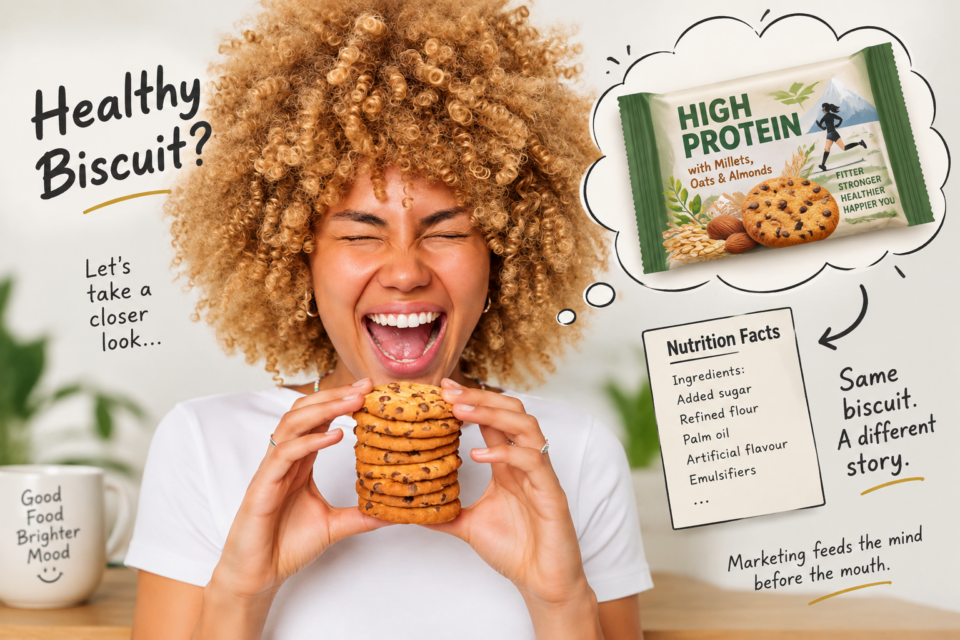
A patient recently placed a packet of biscuits on my table. “Doctor, these are healthy. I have stopped ordinary biscuits.” The packet had oats, almonds, millets, green leaves, mountains and enough nutritional virtue to make me feel personally inadequate. HIGH PROTEIN marched across the front, while a remarkably thin woman appeared to be running towards the Himalayas. I turned it over, read the small print and said, “Interesting. Your biscuit has achieved something many of my patients are still trying to achieve.” He looked worried. “What, doctor?” “It has joined a gym.” We laughed, but the biscuit stayed in my mind. It had acquired a biography. My patient had not merely bought a snack; he had bought the healthier person the packet promised he was becoming. That is the cleverness of modern food: it enters your brain several seconds before it enters your mouth.
Behavioural scientists call one version of this the health-halo effect. Give a food one admirable quality, and the mind quietly upgrades the entire product. In experiments, an “organic” label has led people to estimate fewer calories in foods; even more so, researchers found that fair-trade labels could make foods seem healthier and lead people to eat more. Fair trade is an ethical idea, not a metabolic one, but apparently once chocolate develops good morals, the hand feels entitled to another piece.
The trick becomes stranger when nothing about the food changes at all. Experimental work has shown that placing health claims such as “high protein” or “low fat” on identical snacks can alter how healthy people perceive them, reduce guilt, and increase consumption. No molecule changed. Only the sentence did, and the sentence changed the eater. We spend enormous energy discussing carbohydrate, fat and protein while overlooking another remarkably potent ingredient in modern food: permission.
Protein deserves its popularity; it is essential, and preserving muscle becomes increasingly important with age. But the word now possesses such magical powers that almost anything standing beside it acquires a gym membership. We have protein cookies, protein chips, protein cereal and protein water. At this rate, Bengaluru potholes will soon advertise seven grams of protein per serving. Millets have enjoyed a similar promotion: ragi travelled from grandmother’s kitchen to the premium supermarket, acquired English adjectives, posed for professional photography and returned costing several times more. We did not rediscover millet; we sent it for an MBA.
The more profound surprise, however, lies inside the food rather than on the packet. In a tightly controlled US National Institutes of Health experiment, adults lived in a research unit and were offered either ultra-processed or unprocessed diets, matched for several nutritional variables. They could eat as much as they wished. On the ultra-processed diet, they spontaneously consumed roughly 500 extra calories a day and gained weight; on the unprocessed diet, they lost weight. Nobody instructed them to overeat, and there was no grandmother following them around the ward saying, “One last spoon, otherwise I will feel bad.”
Why they ate more is scientifically more interesting than simply declaring “processed food bad.” Eating speed, energy density, palatability and the physical properties of food appear to matter. Food has architecture. An apple is not merely apple juice waiting for a mixer grinder; its water, fibre and cellular structure affect how it is eaten and digested. Grinding, juicing, puffing, and extruding can alter that structure, meaning two foods that look surprisingly similar on a nutrition spreadsheet need not behave identically at the dining table.
Our traditional kitchens manipulated this architecture without ever giving it a scientific name. We soaked, sprouted, fermented, pounded, roasted and ground. Idli batter fermented while the household slept; dal arrived with water and fibre; groundnuts demanded chewing; and guava came with seeds, apparently appointed to slow negotiations. This does not make grandmother infallible—she was an excellent cook, not a randomised controlled trial in a saree—but many older foods possessed one remarkable advantage: they did not have to explain themselves.
A banana contained banana. An egg arrived in its own biodegradable packaging. Curd did not announce LIVE-CULTURE GUT TECHNOLOGY on the steel bowl, and sambar never called itself a “lentil-based plant-protein phytonutrient system,” although I may just have given Koramangala its next ₹295 lunch.
Modern packaging does something different: it begins feeding us before we eat. Green suggests nature, rustic brown whispers wholesomeness, an athlete lends fitness, and a millet stalk lends ancestral wisdom. This explains the peculiar patient who suspiciously examines half a banana—“Doctor, sugar?”—but peacefully finishes a packet of millet snacks because a farm is drawn on it. The banana has not lost on nutrition. It has lost on public relations.
Even NO ADDED SUGAR illustrates the problem. It can be accurate and useful information, but our brains often enlarge a specific claim into a general blessing. The same can happen with “cholesterol free” on foods that naturally contain no dietary cholesterol. It is like hanging a large board outside my clinic saying NO CROCODILES INSIDE: completely true, wonderfully reassuring and almost certainly not the information you came for.
I no longer think “read the label” is sufficient advice. Before turning the packet over, study the front for two seconds and ask what it has already made you feel. Has “protein” made you feel athletic, “millet” generous with the portion, “organic” relaxed about calories, or “baked” uninterested in everything else? Sometimes the most powerful ingredient is not inside the packet at all. It is the permission the packet has quietly placed inside your head.
That matters because health is rarely destroyed by one spectacular meal. After decades of seeing patients, I have become much more interested in ordinary Tuesdays. The gulab jamun at your cousin’s wedding is easy to remember and easy to blame. The two biscuits with tea every afternoon, the sweet drink at the desk, the handful eaten directly from the packet and the dinner portion that quietly expanded over ten years are less theatrical. The spectacular meal gets photographed; the ordinary meal eventually appears in the blood report.
Perhaps that is the real lesson hiding behind our modern health-food obsession. We have never known more about nutrition, yet eating has rarely been accompanied by so much anxiety. People count protein, fear bananas, photograph ingredient lists, monitor glucose curves and wonder whether their almonds should be soaked facing east. Food has become an entrance examination, with the syllabus changing every six months.
It need not be so complicated. Eat mostly foods whose identities are obvious. Let vegetables take up a substantial space on the plate, eat whole fruits appropriately, get enough protein, choose grains wisely, and enjoy traditional foods that suit you without assuming that everything ancient is medicinal. Packaged foods are useful servants of modern life, not enemies, but whenever a packet promises extraordinary virtue, become curious rather than obedient.
The next time you stand in a Bengaluru supermarket holding a handsome packet decorated with mountains, green leaves, ancient grains, smiling families and enough vegetation to qualify as Lalbagh, look at it for a moment before turning it around. Ask yourself what the packet has already persuaded you to believe.
The small print will tell you something about the food, but the large print may reveal something far more interesting about the person holding it. After nearly thirty years of reading blood reports, I have learnt that important truths about health often hide in small print.
A blood report and a biscuit packet both contain numbers. The blood report has one disadvantage: nobody has hired a copywriter to make its numbers look healthy.

3 comments
You hit the nail on the head, Doctor. The processed food industry has mastered the art of manufactured FOMO. They make you feel like you are falling behind or losing out if you aren’t consuming the latest trend. Take “date bites” or modern fitness biscuits, for example. It is ironic how we used to turn our noses up at the fresh date laddus our mothers and grandmothers lovingly made at home. Yet today, people blindly buy the exact same thing in a commercial packet for triple the cost. We are substituting ancestral wisdom with social media algorithms. The reality is that true health isn’t found on Instagram or Facebook; it’s found by returning to our roots and embracing the simple, whole foods we grew up with.
You hit the nail on the head, Doctor. The processed food industry has mastered the art of manufactured FOMO. They make you feel like you are falling behind or losing out if you aren’t consuming the latest trend. Take “date bites” or modern fitness biscuits, for example. It is ironic how we used to turn our noses up at the fresh date laddus our mothers and grandmothers lovingly made at home. Yet today, people blindly buy the exact same thing in a commercial packet for triple the cost. We are substituting ancestral wisdom with social media algorithms. The reality is that true health isn’t found on Instagram or Facebook; it’s found by returning to our roots and embracing the simple, whole foods we grew up with. thank you for beatuifulul insite
thank you