
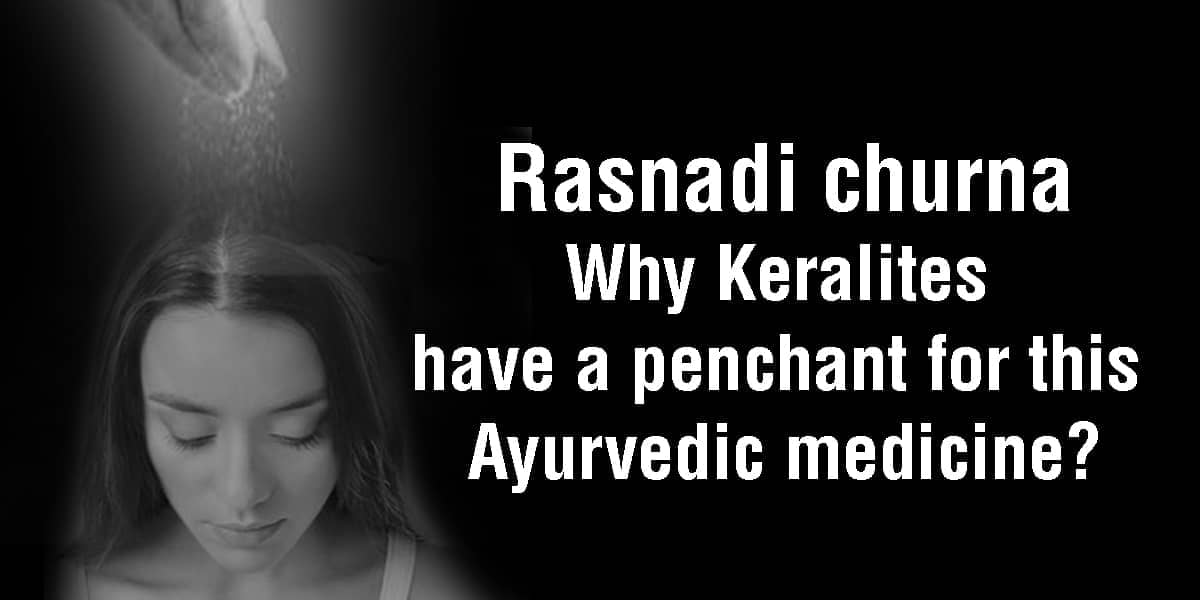
In a Kerala home, a head bath is not officially over when the tap is closed. It is over when somebody—usually a mother or grandmother—appears, parts the wet hair with one finger and places a pinch of brown powder on the crown. Refuse, and she may look at you as though you have personally invited sinusitis into the family.
The powder is Rasnadi Churna, or Rasnadi Choornam as it is commonly called in Kerala. It often sits beside the coconut oil, ready after a head bath, an oil massage, a swim or a thorough drenching in the monsoon. In some Malayali families, the little bottle even makes its way into the travel bag. Chargers may be forgotten. Rasnadi Churna has already been packed.
And no, it has nothing to do with the orange drink called Rasna. One is a classical Ayurvedic formulation. The other coloured the tongues of an entire generation.
Rasnadi Churna is neither a women’s cosmetic nor a men’s medicine. The post-bath pinch has traditionally crossed gender and age: fathers after an oil bath, mothers after washing their hair, and older children under an elder’s watchful finger. Its use depends more on the person, the complaint and skin sensitivity than on whether the scalp belongs to a man or a woman.
Why did this peculiar ritual become so deeply rooted in Kerala?
The answer begins with the weather. The Kerala monsoon does not merely arrive; it moves in, unpacks and begins rearranging daily life. Clothes refuse to dry. Towels develop doubts about their purpose. Hair remains damp, rooms become humid, and people prone to rhinitis begin their familiar orchestra of sneezing, sniffing and searching for handkerchiefs.
Kerala also has a strong tradition of applying oil to the scalp and body before bathing. In Ayurvedic terminology, oil is heavy and unctuous, while Rasnadi Churna is predominantly aromatic and pungent, and is traditionally regarded as light and warming. The powder became a small counterpoint after the bath, particularly for people who experienced coldness, head heaviness, a runny nose, or a headache after washing their hair.
Despite its name, Rasnadi Churna is not simply powdered rasna. It appears in Sahasrayogam, an influential Kerala Ayurvedic compendium containing more than a thousand formulations. The version documented in a 2024 scholarly review lists 24 ingredients, including rasna, ashwagandha, devadaru, vacha, dry ginger, black pepper, long pepper, turmeric, liquorice, vetiver, sandalwood and asafoetida.
It is commonly called a herbal powder, although the classic recipe also includes gairika, a mineral substance. A few ingredients survive under regional names that modern scholars do not interpret uniformly. The formula has travelled across centuries more successfully than every ingredient’s passport.
Each ingredient was traditionally powdered separately and then mixed in equal proportion. That creates the delightful paradox at the heart of the ritual: twenty-four ingredients, considerable pharmaceutical effort, and a final dose small enough to sit on a fingertip. Modern wellness frequently believes that more must work better. Kerala chose precision.
The traditional method is equally fascinating. Excess water is first removed from the hair. Depending on family practice, the powder is applied while the scalp is still slightly damp or after the hair has been dried. One or two pinches are rubbed gently near the crown. Some households also apply a tiny amount to the backs of the ears.
Older instructions even turned the body into its own measuring instrument. The location on the crown was found by using the span between the thumb and middle finger, extending from the tip of the nose towards the scalp. Before bathroom mirrors, measuring tapes and anatomical diagrams entered ordinary homes, the medicine already had a dose, a destination and a built-in ruler.
What does that pinch actually do?
Ayurveda describes many of its ingredients as kapha-reducing and traditionally uses the formulation for headache, runny nose, and heaviness of the head. Users often report a warming aroma and a subjective sense of freshness or lightness. These observations are worth recording, but they should not be inflated into imaginary anatomy. Powder placed on the crown does not physically travel through the skull and enter the sinuses.
Modern medicine, however, offers an intriguing parallel. Studies of menthol show that people may feel their nose becoming clearer even when instruments detect no meaningful reduction in airway resistance. Sensory nerves can change the experience of congestion without mechanically opening the airway. One controlled study found precisely this difference between perceived relief and measured resistance.
Rasnadi Churna is not menthol, and no study has demonstrated that it works through the same pathway. But its aromatic and pungent ingredients raise an excellent research question: could some of the reported lightness be sensory modulation rather than physical decongestion? Sometimes the body’s experience changes before its plumbing does.
There is another point on which grandmother was partly wrong and curiously observant. Wet hair cannot cause a viral cold. Viruses cause colds; water on the scalp does not manufacture them. Medical guidance is clear on this. Yet temperature changes and cold air can trigger a runny nose, congestion, or burning in people with nasal hyperreactivity, including those with non-allergic rhinitis. Modern reviews recognise weather and temperature as potential triggers of rhinitis.
Grandmother may have confused infection with irritation, but she had been watching the nose carefully.
Kerala is not alone in connecting wet hair, cold weather and illness. Similar warnings are heard in Latin America, Europe, West Asia and East Asia. Many cultures also developed hair powders or clays: European hair powders absorbed oil, Middle Eastern clays cleansed the scalp, and Indian households used shikakai, green gram, and other plant powders. Modern dry shampoo continues part of that physical logic.
But Rasnadi Churna remains distinctive. Dry shampoo is distributed through the hair to absorb oil. Rasnadi Churna is applied in a minute quantity to a chosen point for traditional medicinal purposes. Other cultures powdered the hair. Kerala chose one pinch, and gave it an address.
The evidence must nevertheless be stated honestly. Rasnadi Churna has generations of witnesses but almost no rigorous clinical trials testing this exact post-bath ritual. The available modern paper documents its ingredients, classical rationale and traditional use; it does not prove that a pinch on the scalp prevents viral colds or cures sinusitis. The tradition is intriguing. The scientific verdict remains unfinished.
Use should therefore remain modest. Choose a reputable licensed manufacturer, because ingredient lists can vary. Keep the container dry, avoid contact with eyes and broken skin, and stop if irritation, rash, coughing, or wheezing occurs. The powder should not be deliberately inhaled into the nostrils. Infants, very young children and people with asthma or highly sensitive skin require particular caution. Internal consumption and medicinal pastes belong under an Ayurvedic physician’s guidance.
Persistent fever, severe facial pain, swelling around the eyes, breathing difficulty or recurring nasal symptoms need medical evaluation, not another pinch.
The real beauty of Rasnadi Churna is not that it cures arthritis, reverses ageing, regulates menstruation and defeats influenza before breakfast. Such extravagant claims only make a fascinating tradition sound like a roadside advertisement. Its wonder is smaller, older and more believable.
Some medical knowledge was transmitted through renowned Sanskrit texts and universities. Some survived quietly in regional Malayalam books, physicians’ dispensaries, bathroom shelves and mothers’ fingers. What looks like a household habit is, in fact, a manuscript still being performed.
Twenty-four ingredients. One fingertip. Rain outside, wet hair inside, and a warm pinch of inherited weather wisdom placed carefully between the two.

3 comments
GOOD ARTICLE
VERY HELPFUL
submit is just great and that i can suppose you are a professional on this subject.