
I usually hear it halfway through the consultation, offered casually, almost proudly. “Doctor, honestly, I wasn’t even hungry, but everyone was eating.” The sentence appears to explain everything. In fact, it explains how eating has quietly changed its purpose. Hunger has been demoted. Witnesses have been promoted.
Food in India once waited its turn. Sweets waited for festivals. Rich food waited for weddings. Even indulgence had etiquette. Today, food behaves like a notification—always available, faintly urgent, impossible to ignore. We eat not because the body asks, but because the moment seems to expect it. Something begins, so we eat. Something ends, so we eat. Something feels dull, so we eat. Hunger, if it appears at all, is treated like an optional setting.
Cinema rehearsed this shift long before social media accelerated it. Watch closely, and you’ll see that emotions now require accompaniments. Celebration needs alcohol. Stress dissolves in alcohol. Romance arrives only when dessert appears. Silence looks suspicious unless someone is chewing. Fast-food advertising conveyed the same lesson in parallel—two-minute noodles for comfort, chips for fun, burgers for togetherness—teaching a generation that eating quickly, repeatedly, and without hunger was not indulgence but the norm. These scenes do not instruct us directly. They train us gently. The brain is an obedient student. Repetition does the work.
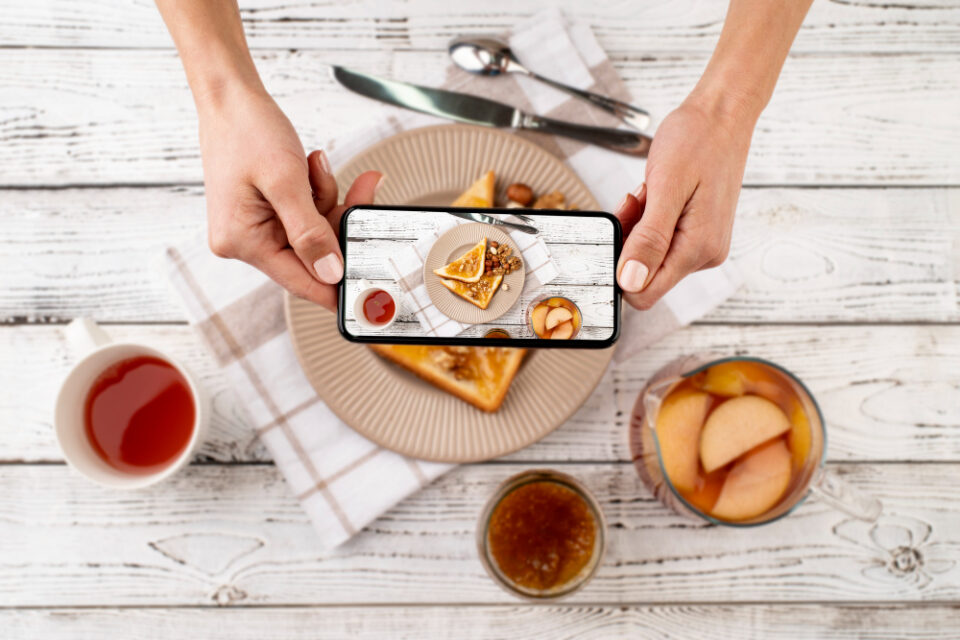
Social media finished the job. Reels turned eating into evidence. Food must now look convincing before it tastes convincing. Texture matters more than digestion. Colour matters more than timing. Plates arrive, phones rise, and the meal cools patiently while everyone ensures it has been properly witnessed. I have watched groups order dessert not because they wanted it, but because the table looked unfinished without it. They ate it without pleasure. They photographed it with care.
There is a behavioural detail most people miss. Humans evolved to eat socially because, for most of history, eating together meant safety. If others were eating, it meant predators were absent, and food was available. The nervous system still believes this. When everyone around you eats, appetite switches on automatically—even if the body does not need fuel. This instinct once protected us. Today, it traps us. The brain cannot distinguish between a village feast and a sponsored reel.
What makes this era especially strange is that many people who eat constantly no longer enjoy food very much. They rush through it. They multitask. They discuss the next meal while chewing the current one. Pleasure has migrated. It no longer lives on the tongue. It lives in proof. Satisfaction comes not from digestion, but from validation. Likes arrive faster than satiety. Biology rarely wins that race.
In the clinic, the consequences arrive quietly. People report bloating after modest meals, a sense of heaviness without satisfaction, and fatigue despite “eating well.” This is not gluttony. It is confusing. The gut is being asked to digest food that arrived without appetite, at a time it did not expect, in quantities it did not request. It copes for a while. Then it begins to object.
Coffee deserves special mention because it has pulled off a remarkable cultural trick: it has turned fatigue into a character flaw. Many young people do not drink coffee because they enjoy it. They drink it because it signals alertness, ambition, and belonging. A coffee cup says, “I am busy, not broken.” Rest, unfortunately, has terrible branding. I meet people who no longer use coffee to wake up, but to remain acceptable. When sleep protests, they call it insomnia, not negotiation.
What almost never enters public conversation is frequency. Most people do not overeat dramatically. They overeat politely—small bites, frequent sips, shared plates, constant tasting. The digestive system never receives a closing bell. From a medical point of view, this matters far more than the occasional feast. Bodies expect intervals. Without them, they store, inflame, and miscommunicate. The problem is not celebration. It is the absence of recovery.
Something else has shifted quietly. Refusal has become awkward. Young people apologise for not ordering. They explain why they are not drinking. They feel rude saying no to dessert. Excess needs no explanation; restraint does. When culture makes saying no antisocial, the body eventually says no on your behalf.
Food is not the villain. Context is. When eating becomes performance, the stomach becomes an afterthought. When celebration becomes consumption, repair disappears. When every moment demands a treat, the body loses its sense of rhythm.
The fix is not discipline or detox. It is attention. Eating fewer times, not necessarily less food. Letting hunger arrive before responding. Allowing some meals to remain unrecorded, unshared, almost private. Enjoying food enough to stop eating it.
The body, unlike social media, keeps impeccable records. Every unnecessary snack, every coffee used as courage, every dessert eaten for display leaves a small signature. Disease rarely arrives as punishment. It arrives as delayed feedback.
One day, someone sits across from a doctor and asks why eating feels exhausting now. The uncomfortable answer is that eating stopped listening to the body a long time ago. It started listening to the audience instead. Applause fades quickly. Physiology has a longer memory.
I have written a book.
If this blog spoke to you, the book will stay with you longer.
