
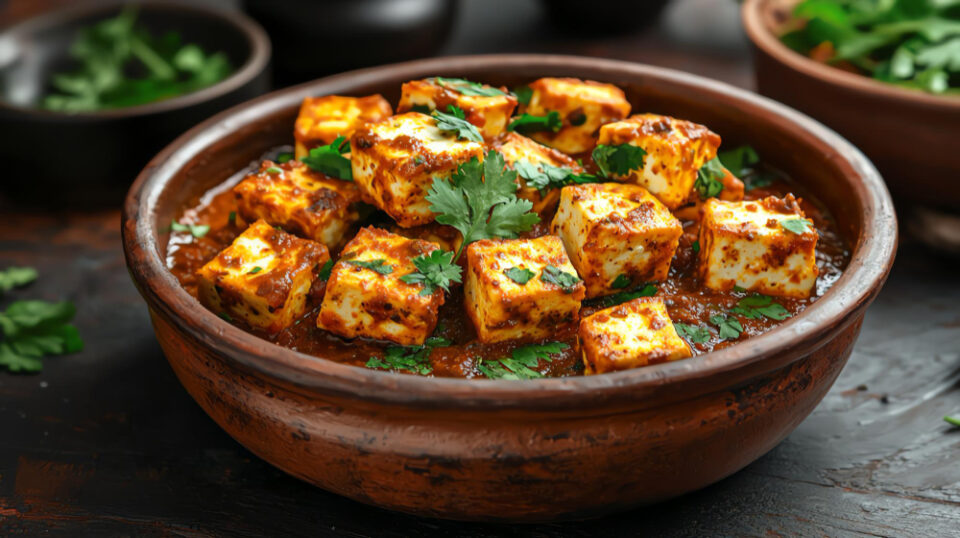
Paneer once had a respectable biography. It began as milk, suffered an acidic crisis, separated from its whey, spent half an hour beneath a heavy vessel and emerged ready for marriage. It had no additives, no marketing department and no reason to hide its parents. Then somebody in the food industry looked at this innocent white cube and asked the question that has disturbed cows ever since: Must milk really be involved?
The answer arrived in a bucket of palm oil.
Analogue paneer is a factory-made imitation designed to look, feel and cook like paneer while costing much less. Milk fat may be partly or completely replaced with palm oil or another vegetable fat. Starch provides body. Milk powder or vegetable protein may be added, while emulsifiers and stabilisers persuade ingredients with no natural affection for one another to remain together. The result is pale, firm, obedient and capable of sitting in orange gravy without attracting suspicion. It is the culinary equivalent of a man entering a wedding in a borrowed sherwani and being mistaken for the groom.
Real paneer is beautifully simple. Milk contains casein proteins floating in tiny bundles. When heated milk meets lemon juice, vinegar or another suitable acid, those bundles lose their mutual dislike and gather into a soft network, trapping milk fat and water. Drain the whey, press the curds, and paneer appears. It is advanced chemistry conducted with a vessel, a cloth and an aunt standing nearby saying, “Press it properly.”
Analogue paneer performs the trick backwards. Instead of allowing milk proteins to build the structure naturally, manufacturers assemble a paneer-like structure from cheaper components. Real paneer forms; analogue paneer is formulated. One is a dairy product. The other is an edible impersonation with excellent posture.
This distinction matters because “analogue” does not automatically mean poisonous. Margarine imitates butter. Plant-based meat imitates meat. Western supermarkets contain shelves of dairy alternatives, cheese substitutes and imitation cheese. America’s food regulator expects such products to carry an accurate common or descriptive name; European rules are stricter and generally reserve words such as milk, butter, cheese and yoghurt for dairy products. The West has analogue foods too. The difference is that the substitute is more likely to arrive wearing a name badge instead of hiding behind the curtains. US FDA guidance, European rules
The Indian controversy is therefore not merely about inventing a substitute. It is about quietly serving that substitute as genuine paneer. An honestly labelled vegetable-fat product is one thing; selling it as milk paneer is another. The recipe creates the analogue. The lie creates the fake.
For years, that lie floated peacefully in restaurant gravy. Then Tukaram Mundhe went out for dinner.
Mundhe, Maharashtra’s Food Safety Commissioner, examined the paneer served to him and suspected that it was not genuine. He advised his companions not to eat it, questioned the restaurant management and gave the establishment 24 hours to correct its violations. Officers inspected it the following day. Most diners ask whether the paneer is soft. Mundhe appears capable of asking whether it can produce its birth certificate, laboratory report and maternal grandfather’s address. Mundhe’s restaurant account
His suspicion was not a lonely one. Maharashtra authorities reported that 35.4 per cent of tested paneer samples were non-compliant. The state issued a one-year prohibition order on analogue paneer on July 30, 2026; the decision became national news in early August. Chhattisgarh, Gujarat and Madhya Pradesh also acted. Karnataka’s one-year prohibition took effect on August 17 and was notified on August 22. Analogue paneer, having spent years avoiding introductions, was suddenly the most discussed guest at the buffet.
Why did it spread so widely? Follow the money; it generally reaches the kitchen before the waiter does. Genuine paneer requires considerable milk, careful handling, refrigeration and protection from spoilage. Analogue versions can be produced cheaply, uniformly and in bulk. In Madhya Pradesh, genuine paneer was recently reported at around ₹400 a kilogram, while substitutes could cost roughly half. Prices vary, but temptation does not. When a restaurant offers unlimited paneer at a price that barely covers the onions, economics has probably entered the kitchen wearing a chef’s cap.
Is analogue paneer dangerous? Not necessarily. A properly manufactured substitute made with approved, good-quality ingredients is not instant poison. Palm oil does not become cyanide merely because it has been cut into cubes. But nutritional deception has consequences. People eat paneer expecting high-quality protein, calcium and the nourishment of milk. An imitation containing more starch and vegetable fat may provide considerably less protein and calcium. A vegetarian child, a gym-going youngster or an older adult may believe they are eating protein when much of the cube is merely providing texture.
The risks become more serious when production moves into illegal or unhygienic units. Poor-quality oils, contaminated water, excessive starch, non-permitted chemicals, unsafe acids, and careless storage can turn commercial cleverness into a public health problem. Some products may also contain substantial saturated fat or sodium. The chief danger is not one authorised ingredient viewed in isolation; it is an unknown formulation made by an unknown person and sold under a false identity. Even Sherlock Holmes preferred suspects with addresses.
Can we identify fake paneer at home? Rubberiness, unusual smoothness, a starchy taste or oil leaking during cooking may raise suspicion, but none proves guilt. The popular iodine test can indicate the presence of starch; it cannot tell you the complete history of the product. Proper laboratories examine the moisture, protein, and fat composition and can detect plant sterols such as beta-sitosterol, which indicate the presence of vegetable fat. Your tongue is a sincere witness, but it has not completed forensic training.
There is no need to carry iodine to weddings or interrogate every cube under a table lamp. Buy packaged paneer from reliable manufacturers, read the ingredient list, retain the bill, and be cautious about loose paneer sold at an impossibly low price. In restaurants, ask whether paneer made with dairy or an analogue is used. A respectable establishment should answer without behaving as though you have requested its income-tax returns.
Paneer is not merely another ingredient in India. For vegetarians, it is often the protein on the plate; at weddings, it is the principal attraction after the bride. Passing off a cheaper imitation, therefore, exploits nutritional expectations, cultural trust, and the customer’s wallet at once.
India has room for alternatives. We already have artificial silk, artificial intelligence and relatives who display artificial happiness at our success. There may even be room for analogue paneer—provided it introduces itself honestly.
Until then, every suspicious white cube deserves one courteous question.
“Before entering the butter masala, could you kindly tell us whether you have ever met a cow?”

4 comments
I think I have to think twice before ordering paneer recipes
yes
When you are eating it as a cooked dish it’s very hard to tell the difference.
Exactly—that is what makes analogue paneer so difficult to detect. Once cooked in a rich, spicy gravy, taste and texture can deceive us; only honest labelling, reliable sourcing and laboratory testing can confirm what is actually on the plate.