
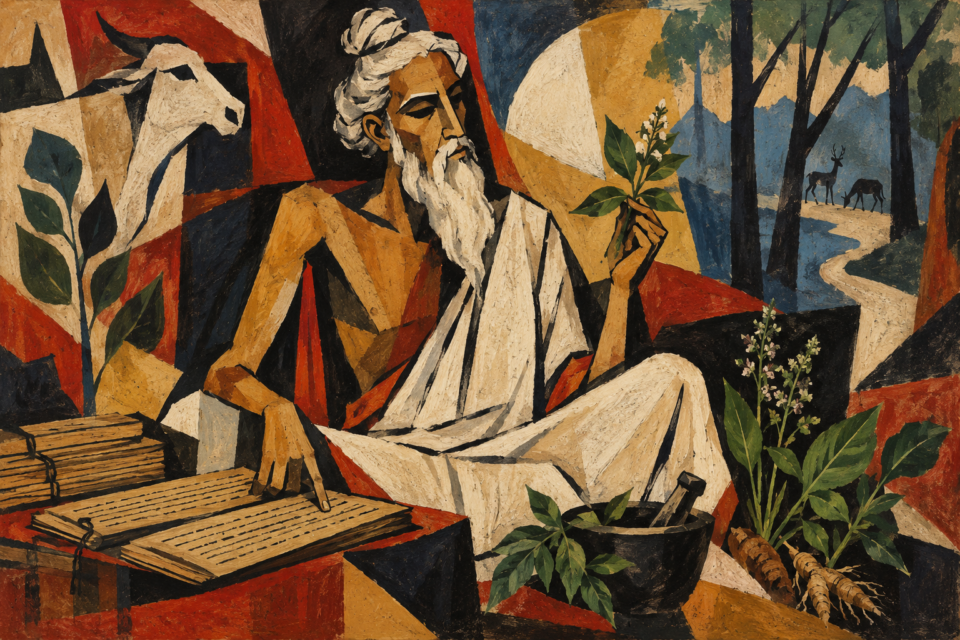
A patient once noticed the thick book on my consultation table and asked, “Doctor, who is Charaka?”
There was no portrait behind me to point towards. Nobody knows Charaka’s face. We have supplied him with one, of course. India dislikes leaving a great man faceless. Artists have given him a flowing beard, peaceful eyes, wooden sandals and the excellent posture of someone who has never waited in Bengaluru traffic. But the honest answer is that we do not know whether Charaka looked anything like him.
I placed my hand on the book and said, “He is the reason I am asking about your sleep when you have come for acidity.”
The patient had already told me about his appetite, bowels, working hours, late dinners, afternoon tea, temper and the recent cold war at home. Until then, he had probably considered my questions a personality defect. Learning that the interrogation was two thousand years old gave it dignity.
Many ways measure a physician’s greatness: discoveries made, diseases treated, institutions built. Charaka offers a stranger test. Remove his name from Indian medicine and see how much of him remains. The long conversation before the prescription. The attention to food and digestion. The suspicion that a symptom may have begun far from the organ displaying it. The insistence that age, season, strength, occupation, habit and state of mind alter treatment. His name may disappear from the prescription, but his fingerprints remain all over the consultation.
He is perhaps the most influential doctor in Indian history and among the least biographically available. We do not know with certainty where he was born, exactly when he lived or what he looked like. We are not even sure whether “Charaka” referred only to one man or also to a wandering medical tradition. His fame comes without the usual machinery of fame. No authenticated house. No grave. No signature. No personal diary. Not even enough reliable biography to trouble a schoolchild before an examination. And still he has been arriving at clinics for two millennia.
The book bearing Charaka’s name did not begin with him. According to the tradition preserved within the text, Punarvasu Atreya taught; his disciple Agniveśa gathered those teachings into a medical work; Charaka later revised and enriched it. Centuries afterwards, Dridhabala, a scholar traditionally associated with Kashmir, reconstructed forty-one chapters that were no longer available. One teacher spoke, one student compiled, one physician transformed, and another restored what time had taken away.
Consider the odds against that book reaching us. It had to survive without a printing press, a publisher, cloud storage or a university server sending anxious reminders to back up the files. It lived first through memory and handwritten copies. Palm leaves decayed. Birch bark cracked. Ink faded. Damp entered rooms. Insects ate libraries without reading the reviews. Wars changed borders. Kings vanished. Teachers died before finishing lessons. Scribes skipped lines, misunderstood words and sometimes improved passages that had not asked for improvement. Yet enough survived for the Charaka Samhita to lie on my table in Bengaluru while a man complained about acidity. This is not merely the history of a book. It is a two-thousand-year rescue operation.
I first encountered its force in Belagavi through my professor, Dr Shivanand Hiremath. He was passionate about the Charaka Samhita, but his reverence never made the text untouchable. He opened each verse, questioned it and made it report for clinical duty. Under him, Charaka did not seem like an ancestor seated respectfully in the past. He seemed to step outside for a moment and leave instructions.
We were medical students and therefore impatient. Tell us the disease. Tell us the medicine. Tell us the dose. Charaka seemed determined to delay the prescription until he had examined the universe around the patient. Where does he live? What does he eat repeatedly? What can he actually digest? What season is it? How strong is the illness? How strong is the person carrying it? What work does he do? What has his mind been doing to his body while everybody was blaming the food? We wanted the answer. Charaka kept improving the question.
After nearly thirty years of practice and nearly two lakh patients, I have come to regard that as one of medicine’s most radical habits. A laboratory report tells us what was found in a sample on a particular morning. A consultation must discover the life that produced the sample. The intestine has a timetable. Sleep has creditors. The skin keeps correspondence with the mind. Even the tongue can tell a biography if the doctor stops asking it only to say “Ah.”
Charaka described several ways of knowing. We learn from reliable teaching. We observe directly. We infer what cannot be seen. Then comes yukti: the ability to recognise how several causes may meet and produce one result.
Seeing smoke and inferring fire is intelligence. Seeing dry grass, a rising wind, a row of houses and an unattended flame—and understanding what may happen next—is yukti. Medicine lives in that difference.
A patient rarely arrives with one cause. He brings age, inheritance, appetite, occupation, medication, memory, money, weather, fear and habit. The complaint may fit into one line; the life behind it seldom does.
Every experienced doctor knows the second conversation taking place beneath the spoken one. “I sleep very well,” says the man who can describe the ceiling between two and four every morning. “I have no stress,” says another, before naming twelve relatives responsible for it. “My digestion is excellent,” says a third, opening a bag that contains antacids, digestive powders and enough fennel seeds to begin wholesale trading. The body and its owner do not always report the same.
One of the most astonishing questions in the Charaka Samhita returned with terrifying force during Covid. If people differ in age, food, strength, constitution and habits, why do large numbers of them sometimes fall ill at the same time?
Charaka looked beyond the individual body to what people share: air, water, land, and season. When these common foundations are disturbed, entire communities may suffer. He called this Janapadodhwamsa—the devastation of populations.
The intellectual leap is enormous. The patient is no longer only the person lying on the bed. The patient may also be the water entering every home, the air crossing every wall, the soil growing everybody’s food or a season that has lost its rhythm. The physician’s gaze moves from the pulse at the wrist to the world surrounding it. Sometimes fever is private. Sometimes it is geography speaking through the body.
Charaka’s world is often imagined as one serene sage delivering perfect answers while obedient students memorise them under a tree. The text itself is far livelier. Learned physicians gather, disagree, challenge definitions and improve one another’s conclusions. Even something as ordinary as taste becomes the subject of serious argument. How many tastes are there? What produces them? How do they influence the body?
This matters because Charaka did not treat disagreement as disrespect. Knowledge had to survive questioning before it could be trusted with a human life. He examined correct reasoning, misleading replies, evasions and the ways an argument could fail. A physician, he understood, could harm patients without touching them. A careless idea, spoken with sufficient confidence, may travel farther than an infection.
He was especially suspicious of people who possessed the language of medicine without its judgement. One doctor might know every verse but freeze before a difficult patient. Another might know very little and never freeze at all. The first was incomplete. The second was dangerous. Charaka wanted learning in the mind, experience in the hands and restraint in both.
His instructions followed the physician into the patient’s home. A doctor might be allowed into bedrooms, family disputes, financial anxieties, and fears never spoken aloud elsewhere. None of this was to become material for entertainment outside. Illness made the patient’s privacy negotiable; it did not abolish it. Clinical access was not ownership.
Charaka understood the inequality hidden inside every consultation. In a consultation, the doctor is usually calm and in control. The patient may be frightened, in pain, or revealing things not even the family knows. Charaka understood this imbalance. A doctor therefore needed more than knowledge and skill; without honesty, restraint and compassion, greater skill could simply cause greater harm.
Charaka also expected doctors to recognise the limits of treatment. Some illnesses could be cured, some only controlled, and some could not be helped by further intervention. This was not giving up. It was protecting patients from unnecessary treatment and false hope. Knowing when to start treatment requires expertise; knowing when to stop requires wisdom.
A remedy, in Charaka’s view, was never beneficial merely because it was generally beneficial. For whom? In what quantity? At what age? During which season? With what digestive capacity? Rain can rescue a field in one month and ruin its harvest in another. Timing completes the meaning of the rain.
The same attentiveness extended to the mind. Fear, grief, anger, desire and envy were not decorative emotions floating above the “real” illness. They could enter its making. The mind did not occupy a separate floor above the body. It lived everywhere. The stomach tightened around anxiety. Sleep broke under grief. The skin sometimes announced what the mouth had been trained not to say.
And yet Charaka did not imagine that reason alone contained the whole human being. His medical world had room for prayer, ethical conduct, sacred sound, community and forces that exceeded immediate explanation. He could observe carefully without pretending that everything worth knowing had already become visible. His confidence did not require the universe to become smaller.
Perhaps his most beautiful conviction was that medical knowledge has no final shore. There would always be more to learn because life would continue producing new combinations. A physician may study for decades, treat thousands of people and become highly respected. Then an unassuming patient enters on an ordinary evening and quietly demolishes his favourite certainty. Success can make a doctor eloquent. Failure improves his hearing.
The patient who had asked about Charaka eventually finished his consultation. His illness was not mysterious. Dinner had moved toward midnight, sleep toward one, and exercise toward tomorrow, while the chilli had accepted full responsibility. I explained the treatment and closed the book.
Before leaving, he looked once more at its worn cover.
“So Charaka is still useful?”
I thought of Atreya teaching, Agnivesha gathering, Charaka reshaping and Dridhabala restoring what time had removed. I imagined unnamed scribes bending over fragile manuscripts through the centuries, copying one more line before the light failed. I remembered Dr Shivanand Hiremath opening the same world before us in Belagavi. Kingdoms had disappeared. Libraries had burned. Languages had changed. Medicine had acquired machines capable of looking inside a beating heart.
But the patient was still sitting before the doctor, carrying a life larger than his report.
I opened his case sheet again.
“When did you last eat without looking at your phone?” I asked. The patient smiled. On the table between us, Charaka had asked another question.
