
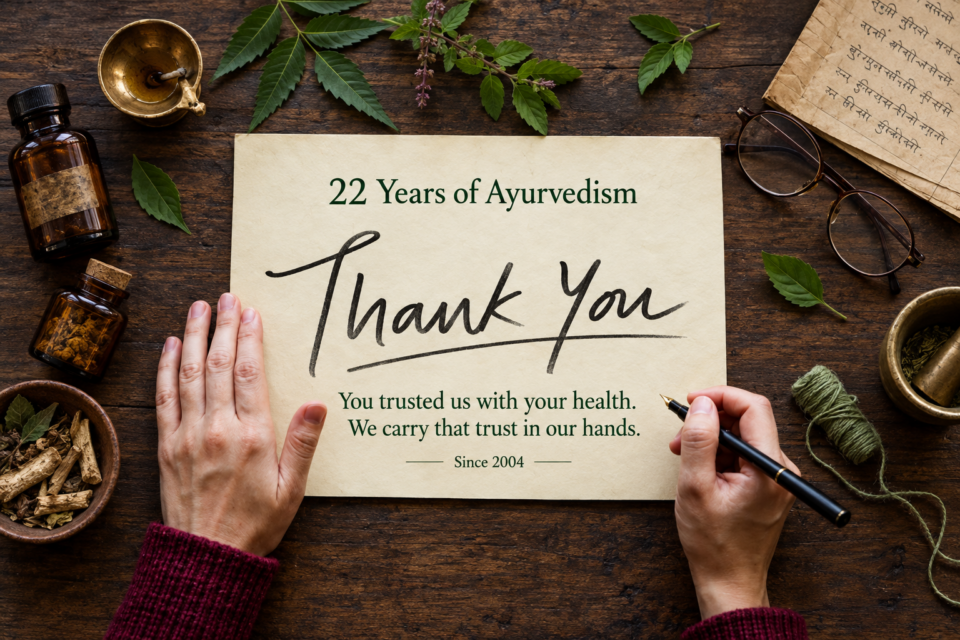
A young woman placed her little daughter in the chair opposite me and said, “Doctor, you treated me when I was her age.”
For a moment, I looked from the child to the mother and felt time perform a small magic trick. The frightened girl who had once sat before me was now the reassuring hand on another frightened girl’s shoulder. In that instant, without ceremony or announcement, Ayurvedism completed twenty-two years.
Years are usually counted on calendars. A clinic counts them differently: by children returning as parents, by prescriptions softened at the folds, by bottles carried home and blessings brought back. Twenty-two years is not merely the distance between 2004 and today. It is the distance between one mother’s hand and her daughter’s.
When Ayurvedism began in 2004, it had two doctors and two tempos. Dr Srikanth took care of the mornings; I arrived in the evening, when Bengaluru returned from work carrying stiff backs, burning stomachs and the day’s unfinished arguments. Between his first patient and my last, the clinic remained awake, listening to the city in shifts.
Through those early days, the door kept opening. People came with coughs that had outlived two winters, knees that had declared independence from staircases and stomachs deeply suspicious of restaurant food. They examined the new clinic, its medicines and its doctors with understandable caution. Some returned. Better still, they sent others. A clinic is truly born not when its board is installed, but when one patient tells another, “Go there.”
Those years gave me an education no university could have designed. A gentleman once asked for “the same brown tablet” that had helped his neighbour’s sister several months earlier. He knew neither its name nor the illness it had treated. His only clinical evidence was that she had been “very happy afterwards.” Thus began my postgraduate training in pharmaceutical archaeology.
Slowly, the clinic acquired its own weather. Mornings carried the fragrance of oils and herbs. Evenings brought office fatigue, Bengaluru dust, and questions saved throughout the day. Medicines travelled home in handbags, cloth bags and occasionally a Nandini milk cover. Patients brought reports in plastic folders and worries without folders. The reports were usually easier to arrange.
A headache rarely came alone. It arrived with a deadline, a housing loan or a manager who sent messages at midnight. Acidity travelled with ambition. Back pain brought a laptop. Sleeplessness knew every family secret. The body spoke first, but life was often standing behind it, quietly supplying the words.
Often, the laboratory report entered the conversation before the patient did. It sat on my table, opened to the frightening number, and was pushed toward me. The patient no longer looked at the report; they looked at my face. I learnt that a doctor’s expression is sometimes the first medicine. Sugar, haemoglobin and cholesterol were printed neatly on the page. Fear sat outside the margins. So did the relief that followed four ordinary words: “We can manage this.”
The years gathered without making a sound. Children grew taller than the parents who brought them. Young couples became mothers and fathers; parents became grandparents. Bengaluru changed its roads, skyline and patience levels. Mobile phones became smarter, traffic became philosophical, and the doctor acquired grey hair, reading glasses and the wisdom never to argue with a grandmother about castor oil.
More than two lakh patients have now sat across from me. It is an impressive number on a poster and a useless one in memory. Memory refuses crowds. It keeps individuals: the woman who slept peacefully after years of pain, the elderly man who climbed the stairs again, the mother whose face changed when I said her child would be fine, the husband who called only to say, “Doctor, she ate today.”
There was laughter too. One patient followed every dietary instruction except the diet. Another stopped sugar but developed a touching loyalty to six “sugar-free” biscuits with tea. Some adjusted their dosage with the confidence of scientists whose research ethics committee consisted entirely of themselves. They kept the clinic human and frequently kept the doctor humble.
Some stories refused to give us the ending we had worked for. An illness advanced despite everything we tried. A diagnosis arrived after time had already closed several doors. On such days, prescriptions became shorter and conversations longer. I learnt to set certainty aside, pull my chair a little closer, and stay there. Cure may sometimes leave the room. A doctor must not leave with it.
Ayurvedism grew because you carried its name beyond its walls: across dining tables, office corridors, apartment lifts, weddings and family conversations. Our finest advertisement was never designed. It was spoken softly: “I know a doctor. Go and meet him.” Each recommendation brought not merely a new patient, but someone else’s faith placed carefully in our hands.
Behind the name stood many quiet hands, including Dr Srikanth’s: hands that examined, arranged medicines, searched crowded shelves, answered anxious questions and deciphered handwriting that occasionally defeated even its author. Ayurvedism may have had one name on its board, but it was carried through twenty-two years by many people.
As the young mother rose to leave, her daughter slipped her hand into hers. I watched them walk towards the door: the child I had once treated leading the child I had just met. Then the door closed softly behind them, leaving twenty-two years of trust, for one lingering moment, in the room.

6 comments
Hearty congratulations on 22 years of the clinic sir. Deepest gratitude for your human touch in your prescriptions. It’s your care and concern that won the trust.
thank you madam
Congratulations Brahma for having successfully been completed 22 years of Ayurvedism. Feel proud as always. All these years you have treated lakhs of patients and cured hundreds of diseases. While that by itself is a great saadhana, what i admire most in you is the healing touch you extended to each one who came to you. That is reflected in every article you wrote. Your write ups are not just description of the ailments and treatments to them, they are much like human stories, written with literary values.
Wish you the best for the future too!
Thank you sir
Many Congratulations on 22 years, Doctor!
Thank you for being my pillar of strength and for your compassionate care.
Wishing you many more years of healing, success and good health.
THANK YOU DEAR