
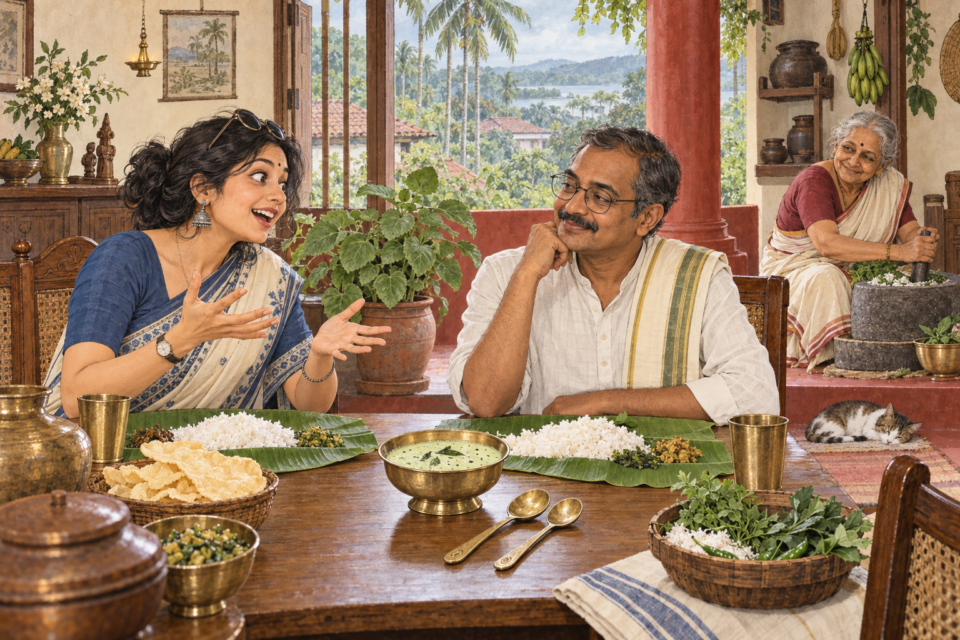
Yesterday Lakshmi came for a follow-up, sat down, and announced tambuli to me the way Vasco da Gama announced India to Europe. “Doctor! You know tambuli? I went to one tambuli mane restaurant. Very different!” Born and brought up in Malleshwaram, she was saying this to a man born in Gokarna, where tambuli is not a discovery; it is Tuesday. I told her gently that coastal homes have thirty-odd varieties, and most houses make one nearly every day. There was a silence. The specific silence of a man at a bus stop explaining cricket to Dravid.
But she was right about one thing. It is different. The difference is not merely culinary. It belongs to that old borderland where food quietly behaves like medicine.
Start with the name. In the kitchen explanation I grew up with, the name is already a prescription — tampu, cool; huli, sour. Whether the philologists would sign off on that, I cannot say. But cool-sour is exactly what it is, and exactly what it is for.
Now the making, because most people have never actually watched it happen. Take one leaf, or one root, a small handful and no more. Warm a spoon of ghee, drop in four or five peppercorns and a pinch of jeera, add the leaf, and lift it off the flame the moment it smells. Grind that with grated fresh coconut into a wet paste. Whisk the paste into fresh curd or thin buttermilk. Salt. Finished. No mustard crackling on top, no onion, no fire after the grinding. Ten minutes, one stone, zero drama. It is one of the very few dishes in which coconut goes in raw and stays raw.
The varieties amount to a small household pharmacopoeia. Doddapatre, our thick, furry Indian borage, when a child’s chest begins rattling. Ondelaga, the Centella that Malnad grandmothers pushed at exam-going boys long before anyone bottled it as a memory capsule. Amruthaballi in the sodden weeks after the monsoon. Curry leaf and coriander for beginners. Ginger and pepper for the new mother. Betel leaf after a heavy wedding lunch. Dill and mint in summer, neem flower at Yugadi when nobody wants it, and everybody needs it, amla in winter, garlic in the wet months in the houses that permit garlic. And in Uttara Kannada during the rains, a tambuli made from wild alambe mushrooms that appear for three weeks and then vanish like a rumour.
It is a course, not a condiment. Two spoons, on the first small mound of rice, eaten before the saaru, before the palya, before anything with ambition. Raita is a supporting actor who wanders in during the second half. Tambuli opens the batting. The old meal grammar says to begin with sweet, keep sour and salt for the middle, and leave the pungent, bitter, and astringent for the end. Tambuli presents itself at the surface as sweet-sour curd and obeys that rule immaculately, while a thoroughly bitter leaf sits hidden inside the bowl, smuggled to the head of the queue. Grandmother knew the rule and then negotiated with it, as Indian grandmothers have negotiated with every rule worth keeping.
Why bitter early might matter at all is genuinely interesting. Bitter receptors, the TAS2R family, are not confined to the tongue. They turn up in the stomach and the intestine, which was an embarrassment for older textbooks. Stimulating them can influence digestive secretion, gut hormones and motility, though precisely what happens depends on the compound and the dose. The Italians arrived at the same instinct by another road, called it an aperitivo, charged six hundred rupees and got a magazine spread. Uttara Kannada called it tambuli, charged nothing, and got a WhatsApp forward.
The ghee is not there for taste. Carvacrol and thymol in doddapatre are genuinely lipophilic; brahmi’s bacosides are saponin glycosides and a more complicated story altogether. Whether a spoon of ghee and a fistful of coconut meaningfully change what the body takes up is an intelligent possibility rather than a demonstrated delivery system. But the structure is suggestive, and no grandmother ever ground a leaf into plain water. As for the peppercorns, pepper may assist digestion and the handling of certain plant compounds, but four kitchen peppercorns are not a clinical bioavailability trial, and anybody who tells you otherwise is standing next to a capsule he wants to sell.
The curd, however, is never heated, and here the classical and the modern converge without either one proving the other. Ashtanga Hridaya’s Sutrasthana 5 is unsentimental about dadhi and its tendency to clog channels. Heat reduces the living microorganisms and rearranges the proteins until the whey walks out sulking. Blend briefly — tambuli wants integration, not interrogation. And the restaurant version, chilled in a refrigerator, quietly sweetened, served in a shot glass with a mint leaf standing in it like a tourist, misses the entire point. Cold is a temperature. Tampu is a quality. A refrigerator cannot supply character.
The world has cousins, though none are siblings. Greek tzatziki, Turkish cacık, Persian mast-o-khiar: yoghurt and cucumber, but companions to a meal rather than openers of it. Bulgarian tarator comes nearest in spirit, cold yoghurt with dill and walnut, taken first. Tamil mor kuzhambu and Punjabi kadhi are the photographic negatives — the same buttermilk, cooked hot, eaten in the middle. No cuisine outside our coast quite managed to treat the dairy as a vehicle and then change the passenger every fortnight, according to the weather, the season, and whoever in the house was complaining.
The deeper lesson is rotation. Coastal kitchens did not turn one useful herb into a lifelong obsession. The leaf changed with the season, the weather and the family’s needs. A little herb in food once or twice a week is not the same as a concentrated extract swallowed every day for months. The plant may be identical; the exposure is not. Dose, form and duration make the difference—three details the supplement industry often prints in the smallest possible font.
Make tambuli with fresh curd that is gently tangy, not sharply sour. Add salt last, blend briefly and serve two spoonfuls, not a bowl. Start children with milder versions, like curry leaf or coriander, then switch the main ingredient with the season instead of falling permanently in love with one fashionable leaf. I told Lakshmi to enjoy the tambuli mane, but also to buy a forty-rupee doddapatre plant for her balcony. A restaurant may introduce you to tambuli; a plant at home can bring it back into everyday life. And somewhere in Sirsi, at half past twelve, a grandmother is still making it without a menu, a measuring spoon or the slightest idea that Bengaluru has just discovered it.
