
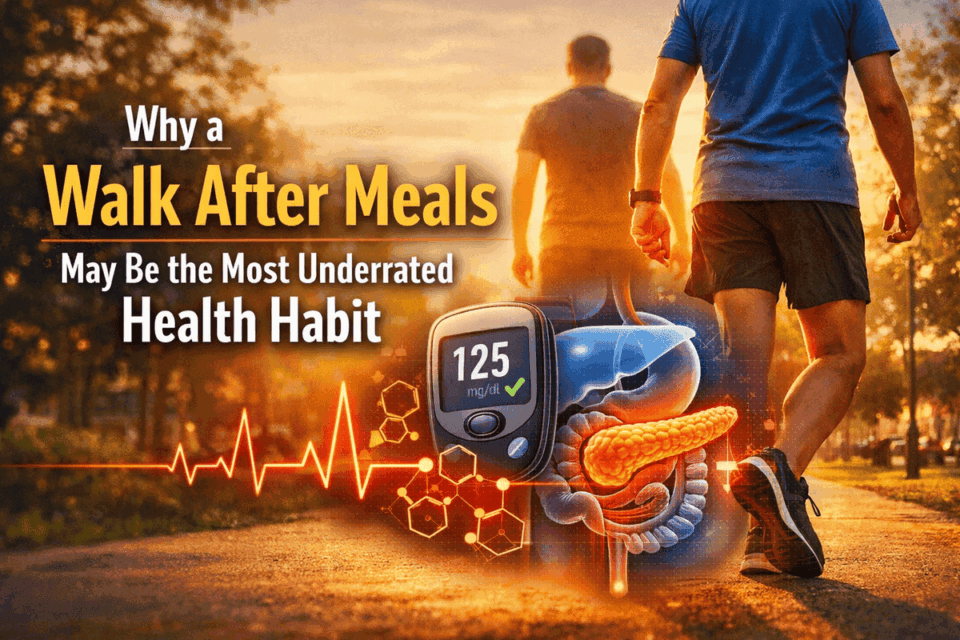
A meal ends. The plate is rinsed. The chair moves back. And in that small domestic sound lies a metabolic decision most people do not know they are making.
For thirty years, I have watched what happens next. Some stand up and walk. Most sit.
Nothing dramatic follows. No alarms ring. No pain announces itself. But inside the body, after every meal, a negotiation begins. Glucose rises. Insulin answers. Triglycerides assemble. Blood thickens slightly with purpose. The pancreas performs its quiet mathematics.
In a healthy body, this is choreography. In a sedentary one, it becomes a rehearsal for disease.
I did not understand the importance of the post-meal hour early in my practice. I focused, like everyone else, on fasting sugars, lipid panels, and morning readings. Patients came with neat numbers and confident reassurances. “Doctor, fasting is 98.” “Doctor, cholesterol is normal.” And yet they felt heavy after meals. Sleepy. Irritable. Fogged.
One software engineer told me, “After lunch, I cannot think. It feels like my brain switches off.” His HbA1c was 6.4. Borderline. Not alarming. But his day was a series of glucose waves—breakfast spike, lunch spike, evening tea spike—followed by long hours in a chair.
I asked him to do something unfashionable. Walk ten to twelve minutes after lunch and dinner. Not brisk. Not heroic. Just enough to feel the body move.
Three months later, his HbA1c was 5.8. He had lost no dramatic weight. He had not joined a gym. He had simply allowed his muscles to participate in digestion.
This is what we forget: muscles are not decoration. They are the body’s largest metabolic organs. When they contract, they open channels that draw glucose directly from the bloodstream, independent of insulin. Even a gentle walk activates GLUT4 transporters, allowing sugar to enter muscle cells without demanding excessive pancreatic effort.
If muscles do not move, the pancreas compensates. If the pancreas compensates long enough, it exhausts.
Type 2 diabetes does not begin with fasting sugar. It begins with thousands of exaggerated post-meal surges that the body quietly manages for years. Postprandial hyperglycemia, more than fasting numbers, predicts cardiovascular events in many populations. In South Asians, who develop insulin resistance at lower body weights, these repeated surges are particularly consequential.
In my clinic in Bengaluru, I see this pattern daily. Lean men with fatty liver. Women with polycystic ovaries who say, “Doctor, my reports are normal, but I feel swollen.” Cardiac patients whose angiograms surprise them. The story often begins not with indulgence but with immobility.
One woman with PCOS struggled for years with irregular cycles. She was not obese. She ate moderately. But she worked from home and moved little after meals. We adjusted her diet modestly. The more significant change was a fifteen-minute walk after lunch and dinner. Within months, her cycles regularised. Her fasting insulin dropped. Her mood stabilised. She once told me, half-amused, “Doctor, I thought hormones were complicated. You are telling me they listen to walking.” They do.
After a meal, the bloodstream carries not only glucose but lipid particles. Postprandial lipemia—the rise of triglyceride-rich remnants—is rarely discussed outside academic circles. Yet arteries are exposed to these particles repeatedly every day. Gentle activity accelerates their clearance. When we sit still, those fat particles stay longer in the blood instead of clearing out quickly.
I remember a businessman who dismissed this advice for years. “Doctor, I go to the gym at 6 am. That is enough.” He did indeed exercise intensely each morning. But after meals, he sat through meetings, car rides, and screens. At 52, he required a stent. His fasting parameters had never looked catastrophic. But metabolism is not a daily summary. It is a series of waves. The danger lies in the repetition of peaks.
There is also the brain.
Patients describe the post-lunch slump as a feeling of laziness. It is rarely laziness. Rapid glucose rises followed by declines alter cognitive performance. Attention fragments. Irritability increases. The 4 pm craving for biscuits is often a rebound from noon excess. Glycemic variability is increasingly linked to mood fluctuations and even long-term cognitive risk.
One retired schoolteacher once told me, “If I sit after eating, I feel heavy in my body and sharp in my words.” He walked around his neighbourhood temple after every meal. “Walking cools my tongue,” he said. His phrase was more precise than he realised. Movement stabilises glucose curves. Stable glucose supports stable neurotransmission.
We once believed walking after meals might disturb digestion. For vigorous exertion, that caution holds. But gentle ambulation enhances circulation, supports vagal tone, and may improve gastric motility in many individuals. Ayurveda, in its dinacharya wisdom, advises a hundred easy steps after meals—shatapada gamana—to kindle digestion without provoking strain. The Japanese have a phrase, shokugo sanpo—a short walk after meals. Civilisations encode physiological truths long before laboratories confirm them.
Timing matters. Insulin sensitivity declines throughout the day. Dinner spikes are often higher and longer than breakfast spikes. In patients wearing continuous glucose monitors, I have seen differences of 20 to 30 mg/dL simply by adding a ten-minute walk after dinner. The evening stroll may matter more than the morning jog.
There are nuances. Frail elderly may prefer seated leg movements or corridor pacing. Those with reflux should avoid brisk movement immediately after heavy meals. The goal is participation, not punishment.
I sometimes tell patients, “In my years of practice, I have rarely seen harm from a ten-minute walk after meals. I have seen considerable harm from avoiding it.”
The modern chair is a powerful invention. It has altered the human metabolic script. We eat to gain energy and then immobilise the very tissues designed to use it. Our ancestors did not make this choice. After eating, they stood because they had to. Today, we sit because we can.
A meal is not only nourishment. It is an instruction. It tells the body what to do with incoming energy. If we sit, the message is stored. If we move, the message is used.
The difference seems trivial in a single afternoon. It is decisive over decades.
After dinner in my neighbourhood, I often see elderly couples walking slowly under streetlights. They are not tracking steps. They are not optimising performance. They are preserving rhythm. Their conversation moves as their legs do. Their glucose rises less sharply. Their arteries rest easier. Their brains stay clearer.
Medicine is sometimes complicated. Sometimes it is not. Between the last bite and the sofa lies a narrow corridor. Walk it.
You force your pancreas to work overtime long before any report warns you.
I have written a book.
If this blog spoke to you, the book will stay with you longer.

2 comments
very informative sir. before reading this blog i assumed i had walked 30 minutes in the morning now i need not walk after lunch or dinner as my 30 minutes walks quota was over but now i will walk 10 minutes in the morning 10 in afternoon after lunch and 10 after dinner.
thank you