
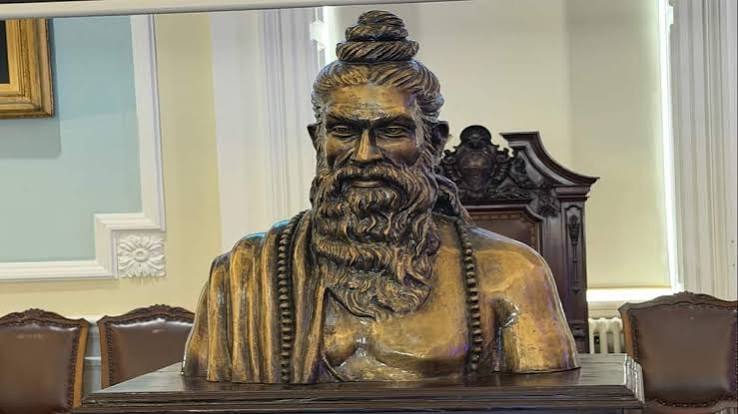
My patient is twenty-nine, runs an AI company that I only pretend to understand, and was scrolling through his phone while I listened to his chest, which is the sort of modern multitasking doctors eventually stop protesting because protest has never once lowered anybody’s screen time.
Halfway through the examination, he turned the screen towards me. Not to ask a question. To find a witness.
A bronze statue had just been installed in the Playfair Auditorium of the Royal College of Surgeons of Edinburgh, an institution that has been training surgeons since 1505 and is old enough to be unimpressed by almost everything. The statue weighed nearly ninety kilograms. The name beneath it carried considerably more weight.
Sushruta.
My patient looked genuinely surprised. He spends his days teaching machines to recognise patterns, yet seemed faintly unsettled that a surgeon who lived twenty-five centuries ago could occupy such comfortable space inside one of the world’s most respected surgical institutions.
I smiled. Only a few weeks earlier, I had met Sushruta myself.
Not in Varanasi. Not in Delhi. In the basement of a surgical college in Melbourne. Before leaving India, I had told my brother Praveen there was one place I absolutely wanted to visit. He agreed immediately, which is one of the advantages of travelling with family: after a certain age, they stop asking why and simply assume you have invented another peculiar mission.
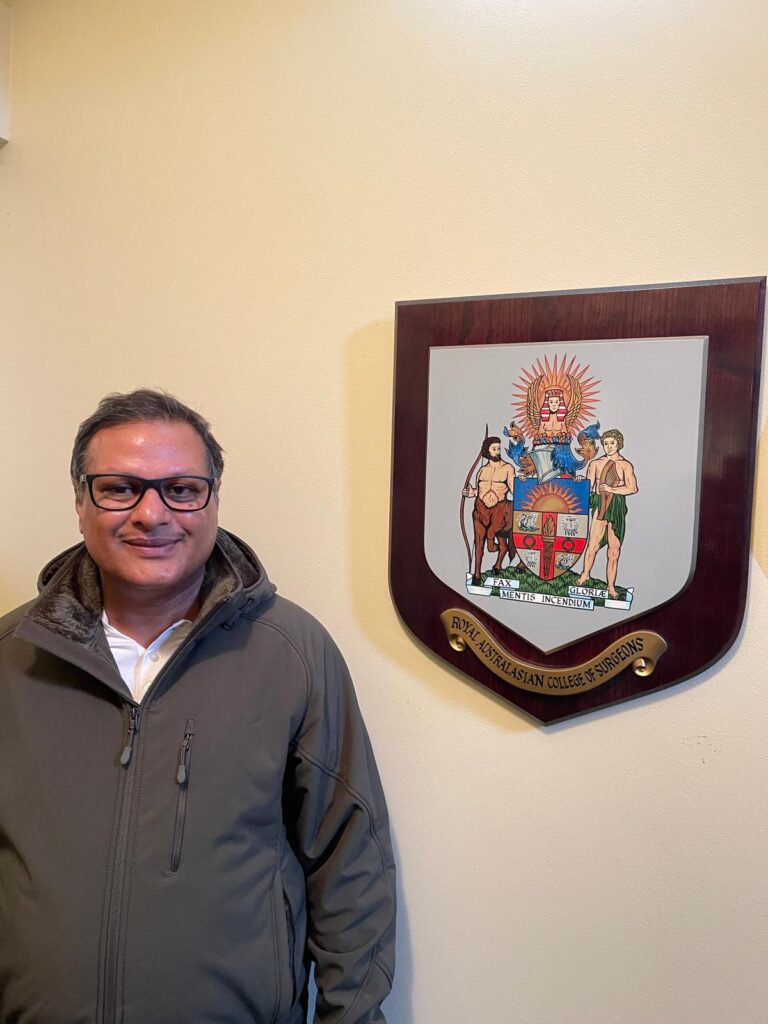
The Royal Australasian College of Surgeons stands with the quiet authority of a place that has educated generations of people trusted with sharp instruments. We asked the receptionist whether we could see the Sushruta statue. She smiled. Not politely. Professionally. It was the smile of someone who had answered exactly that question enough times to know where it would end.
A staff member appeared and asked us to follow her. Then came the first surprise. To meet one of history’s greatest surgeons, we did not climb a staircase. We went downstairs. Within a few steps, Melbourne disappeared.
White walls. Polished floors. A faint smell of disinfectant that somehow convinces every visitor they are standing somewhere important. It wasn’t the silence of a museum. It wasn’t the silence of a hospital. It was the silence of competence, where nobody had anything left to prove.
At the end of the corridor sat Sushruta. White marble. Calm face. Folded composure. He was not displayed as an exotic curiosity from the East or as part of a civilisational exhibit. He simply occupied his place within the working history of surgery. A colleague rather than a guest.
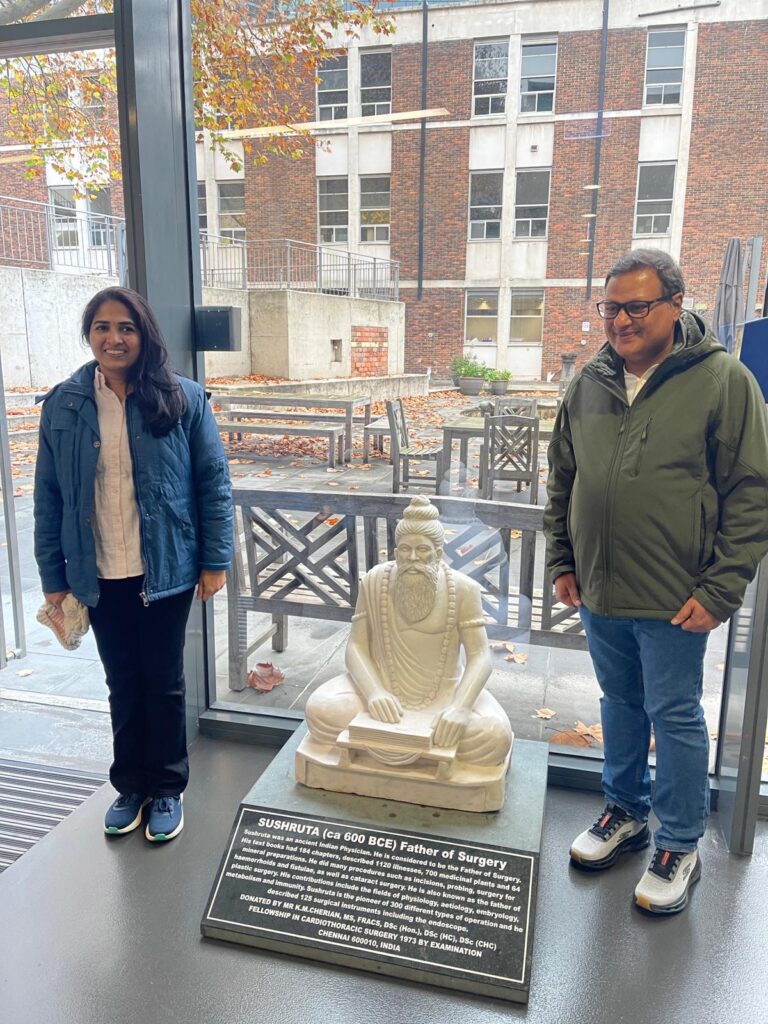
The statue had been donated by the Indian cardiac surgeon Dr K. M. Cherian. A professor mentioned almost casually that Indian doctors regularly came looking for it. I liked that sentence. They were not tourists collecting photographs. They were physicians visiting an ancestor.
Around him stood glass cabinets filled with forceps, clamps, scalpels and instruments whose designs had quietly evolved across centuries. Nobody had built a shrine. Nobody had arranged flowers. Nobody had felt the need to announce the greatness of Indian civilisation. They had simply placed Sushruta where every surgeon who permanently changes a profession eventually belongs. Among colleagues. He had earned the place twenty-five centuries earlier.
Long before anaesthesia, antibiotics or operating microscopes, Sushruta described reconstructing a damaged nose by rotating a flap of skin from the forehead while preserving its blood supply—an idea elegant enough to survive kingdoms, languages and empires.
In 1794, two British surgeons, Thomas Cruso and James Findlay, watched a Maratha vaidya near Pune reconstruct the nose of a bullock-cart driver named Cowasjee, whose nose had been cut off as punishment. They documented every step. Their report travelled to London, appeared in The Gentleman’s Magazine and entered European surgical literature as “the Indian method.” One operation crossed oceans. One idea crossed centuries. Somewhere along the way, it quietly crossed out of our collective memory.
That is the strange arithmetic of civilisation. The world sometimes remembers your inheritance before you do. It would be unfair to say that India completely forgot Sushruta.
There are statues in Goa, Haridwar and Kochi. Institutions preserve Ayurveda. Universities teach it. Generations of vaidyas protected an ancient medical tradition through colonial rule, independence and modernisation. The achievement deserves respect. Yet something curious happened while preserving the system.
Modern medicine and Ayurveda grew up like siblings educated in different boarding schools. They learnt different languages, read different books and gradually stopped recognising the family resemblance.
Today, an Indian medical student can spend five and a half demanding years mastering anatomy, surgery and physiology without ever being invited to compare a contemporary forehead flap with the operation Sushruta described centuries earlier. We honour him as heritage instead of methodology. As culture instead of curriculum. As pride instead of practice.
Perhaps that is why it took an FRCS surgeon like Dr Cherian to place Sushruta inside a modern surgical college. Once you have secured your place in the profession, admiration for your ancestors no longer feels like insecurity. The student still climbing the ladder often looks only upward.
Weeks after returning home, I realised the marble itself was not what had stayed with me. It was the complete absence of insecurity. Nobody there seemed interested in proving that Sushruta deserved his place. They had accepted him as part of the profession’s history and carried on with their work. That quiet confidence impressed me far more than the statue. One day I hope an Indian medical student encounters Sushruta with the same sense of ordinary belonging, without needing to travel halfway across the world.
She should walk past Sushruta on her way to her first suture, glance at him almost absent-mindedly and keep walking, not because she has forgotten him, but because she has never been taught to think of him as someone distant or extraordinary. He would simply be part of the profession she inherited. Like anatomy. Like asepsis. Like the scalpel in her hand.
My patient will probably forget the article he showed me that morning. News disappears, timelines refresh, and yesterday’s surprise becomes today’s scroll. But I hope he remembers the bronze surgeon standing quietly in Edinburgh, because the future of a profession depends less on the technologies it invents than on the ancestors it refuses to forget.
Civilisations rarely vanish in dramatic collapses. They fade more quietly, until one ordinary day, their children need a plaque to recognise the people who built the road beneath their feet.

1 comment
*Hello Doctor,*
That mid-May conversation is still fresh in my mind.
“Must visit Sushrutha on Melbourne trip” — what a beautiful priority.
Thank you for turning that curiosity into pride for me.
I’m sure to introduce him to a few more people visiting Melbourne.
We truly belong to that great country and heritage.
Thanks for making me cherish your Melbourne visit once more.
Regards
Praveen