
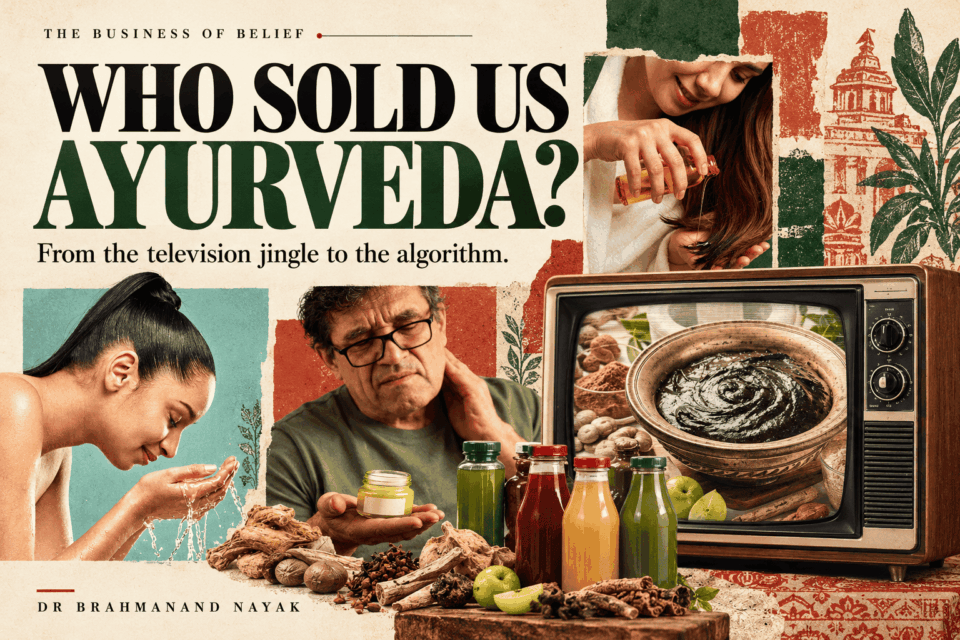
The only advertisement in Indian history written mainly for a tax officer is a turmeric cream jingle. Sometime in the late 1970s, the central excise people looked at Vicco’s Vajradanti and its turmeric cream and ruled them cosmetics, not Ayurvedic medicines, which in the arithmetic of duty means you pay more. A sensible company would have written a polite letter. Vicco composed a tune. Four words: ” Vicco turmeric, nahi cosmetic”, then they rode Doordarshan, the only channel and therefore a captive audience, into every living room in India, while the excise officer’s name has mercifully been lost to history. The company fought the classification in court and, by most accounts, won. I find this the most instructive story in the whole business. Before it sold a single tube, advertising had to argue about what Ayurveda is. Four decades later, with ad budgets that would embarrass a small nation, we are still in that argument, only now the officer has been replaced by an algorithm and the jingle by a reel.
Last Tuesday, a gentleman from Malleshwaram sat in my clinic, holding out his phone like a summons. “Doctor, giloy is good for everything, no? TV mein bola, WhatsApp mein bhi aaya.” I asked him about his bowels. He looked at me the way a man looks when the priest asks for his Aadhaar. He wanted to discuss the herb. I wanted to discuss the person taking it. We had arrived at the same consultation from opposite directions.
After nearly three decades of practice, this change interests me most. People have always brought remedies to the physician. Now they bring an advertisement’s understanding of their bodies. They know which product strengthens immunity before they can describe what troubles them. They have memorised the claim and forgotten the patient.
Yet an account that merely blames advertising would be both convenient and incomplete. These brands entered our homes because they did useful things. They made medicines available, recognisable and portable. They gave people something they could buy again without searching for the person who made it. The question is what happened to Ayurveda as that familiarity became authority.
Think of Zandu. The balm’s name comes from a physician: Vaidya Zandu Bhatt of Jamnagar, whose reputation the company commemorates. The business dates to 1910. A practitioner’s name moved from industrial production to household speech. Today, someone asking for Zandu Balm needs to know nothing about Bhatt, his practice or the medical tradition behind the brand. That is an extraordinary commercial achievement: the physician became so familiar that the physician disappeared.
Nothing about this journey is inherently dishonourable. A reputation can outlive its maker through a dependable medicine. But something changes when the name can recommend the product without anyone having to explain it. The trust once attached to a practitioner becomes something a company can carry from one generation of buyers to another.
Kottakkal offers a different journey. Arya Vaidya Sala, founded by P. S. Varier in 1902, built its name around an institution: physicians, medicines, treatment, teaching and the patient who returned home with a story. Kerala Tourism itself presents Kottakkal as an internationally recognised centre of Ayurveda. Here the place and the practice remain visible behind the name.
Then Kerala acquired three remarkably effective words: “God’s Own Country.” The tourism campaign helped place Ayurveda alongside backwaters, beaches, and a landscape that seemed to promise relief before treatment began. Ayurveda became something people could travel toward, rather than something they merely swallowed when ill. Kerala’s tourism promotion continues to make that association explicit.
It would be careless to say a tourism slogan created Kottakkal’s reputation. The institution had been earning trust long before the campaign. The more interesting relationship runs both ways. Institutions like Kottakkal promised tourists medical substance; tourists gave Kerala’s medical tradition a larger international audience.
It also changed expectations. In the tourist imagination, Ayurveda could become a beautiful room, warm oil and permission to switch off the phone. That is an inviting introduction. It is a selective one. The patient arriving for treatment and the visitor arriving for rejuvenation may enter through similar doors while expecting very different things.
Advertising did not simply sell more Ayurveda. It helped the public decide which parts of Ayurveda to recognise.
In 1999, Himalaya introduced its “Ayurvedic Concepts” range through an unlikely television star: Dadima, an English-speaking grandmother equally at ease on an aeroplane and among youngsters in a café. She explained herbal remedies with the warmth of a family elder and the confidence of a scientist; the character was even presented as having doctorates in molecular biology. This was no grandmother bewildered by modern life. She understood it and had something useful to offer. The advertising was clever because it answered two doubts at once: could something ancient belong in modern life, and could something scientific still feel familiar? Dadima made both seem possible. Ayurveda boarded the flight, speaking fluent English, without leaving behind grandmother’s reassurance.
Himalaya Wellness Company’s story brings this closer to the bathroom mirror. For years, many Indians encountered the company through Liv.52, prescriptions and the chemist’s counter. Later, a teenager with a pimple could encounter it through a face wash, without ever meeting a physician. The company name connected those experiences. Familiarity earned in one setting could make a product in another setting feel less unfamiliar.
The neem face wash campaigns reveal how carefully this relationship with tradition could be negotiated. In 2017, films poked fun at familiar attempts to tackle pimples with household remedies, including honey, lime juice, toothpaste and besan. The commercial proposition was subtle: the ingredients associated with home could remain reassuring, while the home preparation itself could be presented as inadequate.
Himalaya’s 2023 “OG Pimple Solution” campaign celebrated mothers as their daughters’ first skincare influencers. Earlier films had mocked home remedies; this campaign drew on trust in a mother’s advice. A formulated face wash may offer real advantages over a kitchen mixture. The cleverness lay in keeping the family’s reassurance while steering the purchase toward the brand. Once you notice these transfers, the pharmacy shelf becomes a small history of persuasion.
Vicks VapoRub, an American-origin product, is sold in India as an Ayurvedic proprietary medicine. The familiar ingredients acquire familiar Indian names: pudinah ke phool, karpoor, ajowan ke phool. To the buyer, the result can feel both modern and inherited, something purchased at the chemist’s that somehow already belongs in the family.
The commercial history of its classification deserves more careful documentation than marketing folklore usually provides. The distinction it illustrates, however, is essential. Being classified as an Ayurvedic medicine, having evidence for a particular benefit, and being suitable for a particular patient are three separate matters. A label cannot answer all three.
Amrutanjan, Zandu Balm, Moov and Iodex need little introduction in an Indian home. Someone wakes with a stiff neck, someone bends to lift a bucket, someone returns from a bus journey feeling every pothole. Out comes the familiar balm. Nobody asks which medical tradition it belongs to. They just want to move without saying “ayyo.”
This is precisely why such brands matter. Much of the public’s everyday relationship with Ayurveda has been built through ordinary acts of relief. A balm beside the bed can make the word feel more familiar than a seminar attended by three hundred physicians.
Boroline, BoroPlus and Krack brought similar familiarity to skin care. The cracked heel didn’t need its classical name to become a market. It required a recognisable problem, a product within reach and a promise the buyer could understand. Navratna made cooling the head a memorable proposition; Kesh King put authority directly into its name. Somewhere in this process, the word “Ayurvedic” became reassuring to people who knew very little about Ayurveda.
Hajmola shows that companies could also loosen that association when it suited them. Its appeal could rest on taste, mischief and the pleasurable excuse of digestion. A product need not speak solemnly about tradition to remain familiar in an Indian home. Sometimes the bottle wanted to sit beside the medicine. Sometimes it wanted to sit beside the toffee.
The commercial flexibility is impressive. The same heritage can offer seriousness to one product, gentleness to another and a cheerful background to a third.
Chyawanprash had a more difficult task. It had to turn a complex preparation into an everyday habit. The classical account places it within rasayana: a larger concern with sustaining health, strength and the conditions in which a preparation is taken. Its use belongs to a discussion of the person, digestion, quantity and regimen. Advertising had to compress that conversation into something a family could remember between the evening news and dinner. It found “immunity.”
The word solved several marketing problems at once. It sounded scientific without requiring much explanation. It addressed the mother’s worry about the child, the working adult’s fear of falling ill and the older person’s wish to remain strong. Most usefully, it could be sold before anything was wrong.
Dabur’s campaign with Amitabh Bachchan and Vivek Oberoi helped make this promise visible nationwide. The company’s advertising case study described its effort to explain immunity to mothers and revive growth. That was a communication achievement. A preparation tied to a particular tradition had a reason to sit on the breakfast table every morning.
Competition then required distinctions within the promise. “Double immunity” offered a number people could remember, even when the biological meaning was less easy to explain. Zandu’s Bheem-and-Einstein proposition added strength and intelligence to the family’s shopping list. A child could apparently prepare for both the playground and the mathematics examination with the same spoon.
The problem is not that immunity is imaginary. The problem is that the word makes a complicated system sound like a tank that should always be fuller. Immune function involves recognising threats, responding appropriately and limiting damage. “More” is not, by itself, a useful clinical instruction.
Ayurvedic discussions of disease resistance also require more than a universal upward arrow. Strength, nourishment, digestion, age and circumstances matter. The advertisement must speak to a million families. The physician must decide what to say to this one.
The subsequent chyawanprash disputes made the difference almost comic. Companies argued over ingredient counts, sugar, ghee, methods and comparative superiority. Baidyanath’s “sahi vidhi” campaign challenged rivals’ preparation methods. Dabur contested comparisons. Patanjali and Dabur disputed each other’s advertising. The courts acquired an unexpected acquaintance with herbal jam.
There are legitimate questions here. Composition matters. Manufacturing standards matter. A company should be able to challenge an inaccurate comparison. But a buyer watching these battles could reasonably leave believing the essential clinical decision was whether the correct jar contained forty-something ingredients or fifty-something. The quieter question remained outside the frame: should this person be taking it, in this quantity, for this purpose?
Then the pandemic made that omission consequential.
“Immunity” moved from a desirable quality to a national preoccupation. Chyawanprash, kadha and giloy entered conversations shaped by fear, uncertainty and an urgent wish to do something. Families forwarded advice because they cared. Television supplied confidence. Repetition could give a recommendation authority long before anyone examined its evidence.
That atmosphere was especially favourable to a word like “natural.” It seemed to promise both action and innocence. You could take something, give it to your parents, protect your children, and feel you had added little risk.
Reports of liver injury associated with giloy complicated that reassurance. A multicentre study published in Hepatology Communications described liver injury following its use, including cases with autoimmune features. Such reports require careful interpretation of the product, the patient, competing causes and causality. They cannot be reduced to either “every use is dangerous” or “a traditional herb cannot cause harm.”
For a clinician, the practical question is what was taken, why, how much, for how long and what happened afterwards. Advertising rarely gives those questions equal space.
Patanjali magnified another source of authority: the visible founder. A familiar figure could speak about health, yoga, national pride and consumer choice within the same public identity. The buyer was invited to trust more than a product.
That made the boundary between conviction and evidence particularly important. A person’s sincerity does not establish a cure. A testimonial cannot tell us how many people failed to improve, what other treatments they received or whether the diagnosis was correct. These are ordinary requirements of medical judgment, no matter how popular the speaker.
The Supreme Court proceedings over misleading advertisements brought the size and prominence of public apologies into the argument. It was a revealing concern. A claim can reach millions of homes through music, celebrity, and repetition; its correction may arrive quietly, after the purchase and sometimes after the harm.
Regulation needs to address that imbalance. A prohibited promise does not become acceptable because someone’s favourite guru, a reassuring influencer, or a person in a white coat delivers it. Equally, responsible regulation should distinguish between lawful product information, supportable claims and extravagant assertions. Patients gain little from a contest in which every side demands scrutiny only for its rivals.
My profession cannot sit this one out. Why did we leave the people selling Ayurvedic products to explain Ayurveda to the public? Manufacturers made medicines recognisable, portable and easy to buy again—real benefits, especially where a good practitioner was hard to find. But when a doctor says “wait two weeks” without explaining why, a confident advertisement can sound like the better doctor. Our professional bodies stayed too quiet while promises grew louder.
The phone brought those promises closer. On television, we usually knew when the advertisement began. On a feed, it arrives between a cousin’s holiday photographs and a recipe. Someone describes a personal struggle, shares what helped and recommends a product like a friend passing on a discovery. If present, the payment disclosure is easily forgotten. The recommendation feels personal.
Brands like Kapiva sell directly to consumers in this setting, where an online consultation can put advice within reach and move a customer closer to purchase. The revealing question is what happens when the patient needs no product. Can the consultation end there? Can the adviser recommend someone outside the company? Those answers matter more than the reassuring shade of green on the website.
Now the question goes to a chatbot. It replies with the fluency of someone who understands you, though its answer may draw on brand copy as well as reliable medical information. A sales claim can return sounding like independent advice.
Doctors need to give patients answers worth finding: what might help, what evidence supports it and when to seek an examination. Otherwise, the advertisement gets to explain both the medicine and why it’s needed.
A gentleman from Malleshwaram asked whether to take giloy. I asked about his bowels again. This time he put the phone down and told me what was troubling him.

1 comment
👌👍🙏👏👏👏