
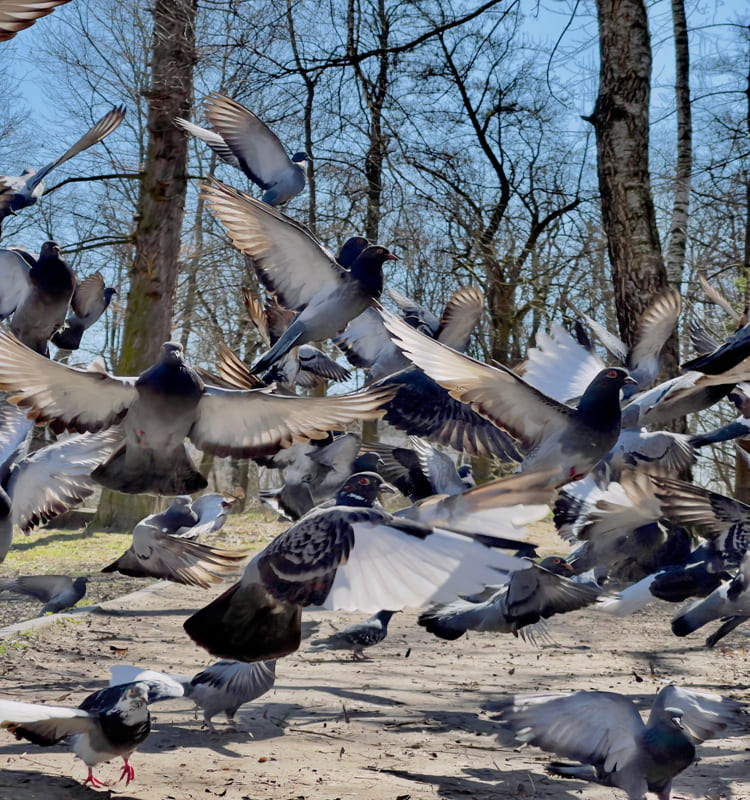
In Bengaluru, pigeons have stopped being the charming background actors of a park scene and turned into the noisy landlords of our balconies. They strut like they own the city, leaving behind a trail of feathers, droppings, and cooing that begins before your alarm clock does. When I was a child, pigeons were a rare treat on temple roofs. Today, they’re as common as traffic jams, and just as hard to get rid of. I’ve had patients tell me they “feed the birds for peace of mind” without realising they are also feeding an invisible problem, one that can sometimes travel straight into the lungs.
The science is quietly unnerving. Between 1941 and 2003, researchers documented 176 instances of illness transmitted from feral pigeons to humans; although these pigeons carried 60 different human-pathogenic organisms, only seven were confirmed to have made the jump. For most healthy adults, the risk is low, so low that many shrug it off as an old wives’ tale. But for someone with a weakened immune system, the odds shift drastically. Studies suggest they could be a thousand times more likely to catch a mycotic infection from pigeon droppings than the general population. It’s not the stuff of horror movies, but it’s enough to make you rethink your balcony cleaning routine. Trouble rarely knocks on the door; it often slips in on silent wings.
I’ve seen this problem appear in subtle ways. A middle-aged gentleman from Jayanagar came in with a persistent cough that resisted every syrup and steam inhalation. After weeks of trial and error, we discovered the culprit: his morning yoga was on a terrace that doubled as a pigeon hangout. The moment he rolled out his mat, the dust and dried droppings stirred into the air. Within a week of shifting indoors, his cough vanished. It wasn’t divine healing—it was simply removing the pigeons from the guest list. In Ayurveda, we say that avoiding the cause is half the cure; modern science agrees.
The real villain here is often the air itself. A staggering 99.4% of recorded transmissions from pigeons to humans happen through aerosols—tiny particles from dried droppings that get stirred up and inhaled. You don’t have to touch the bird or its nest; just sweeping the balcony on a breezy day can be enough. In most cases, the immune system swats away these intruders. But in others—especially in the elderly, transplant patients, or those on long-term steroids—it can open the door to infections like cryptococcosis or psittacosis. These diseases don’t announce themselves with exotic symptoms; they look like plain old fever, cough, or fatigue. The trouble is, by the time you suspect something unusual, the infection may have quietly moved deeper. Sickness often disguises itself as the everyday, until it’s too late to ignore.
Not all pigeon-related trouble is microscopic. There’s the mental health hazard of living under siege. A young mother from Jakkur once told me her newborn’s first nap was interrupted by a pigeon crash-landing onto the crib net. She swore the bird was aiming for the baby powder tin. From that day, her mornings were a battle of brooms and shouts, and her anxiety didn’t need much encouragement. We often underestimate how a constant nuisance erodes our sense of calm. Ayurveda teaches that manasika roga—mental disturbances—can emerge from even low-grade, chronic irritants. You can chant “Shanti” a hundred times, but if a pigeon is cooing by your ear at 4 AM, peace will pack up and leave.
There’s also a cultural tangle in addressing this problem. Feeding pigeons is seen as an act of compassion in many Indian households, tied to rituals and a sense of kindness. Telling someone to stop can feel like you’re asking them to betray their values. But compassion doesn’t have to mean carelessness. You wouldn’t throw rice on the road for rats; why feed pigeons in a way that breeds disease? Genuine kindness looks at the bigger picture. As one elderly lady told me after we discussed the risks: “Doctor, better I feed people who can thank me than birds who leave me a mess.”
Of course, not every cough in Bengaluru is due to pigeons. Our air is already a cocktail of dust, pollen, and vehicle exhaust. But pigeons add a distinct, preventable layer to the mix. The Ayurvedic approach is twofold: strengthen the body and clear the environment. Strengthening immunity through rasayanas like chyawanprash or simple turmeric milk can help, especially for those at higher risk. But no herb can undo the damage of daily inhaling contaminated dust. That’s where the “clear the environment” part comes in—keeping balconies clean, sealing off nesting sites, and wearing a mask during cleaning. It’s not paranoia; it’s prudence.
One of my patients, an elderly man with asthma, taught me something profound. After we discussed the risks, he didn’t just block his balcony vents; he planted a row of tulsi and lemongrass in pots to freshen the air. “Doctor,” he said, “if I have to breathe something in, better it’s this.” His breathing improved, but so did his mood. Sometimes the best defence is not just removing the problem, but replacing it with something life-giving.
Pigeons are not villains by choice. They’re just opportunists making the most of a city that’s left them plenty of parapets, food, and water. We built the high-rises, left the window grills open, and scattered grains with love. And now, like any uninvited guest who’s gotten comfortable, they’re harder to move out. The answer is not fear, but informed coexistence. Seal off your nooks, feed them sparingly and away from human dwellings, and keep your spaces clean. Prevention may feel boring, but it’s much lighter than the weight of disease.
The city may be for all, but the air you breathe is yours to protect.
