
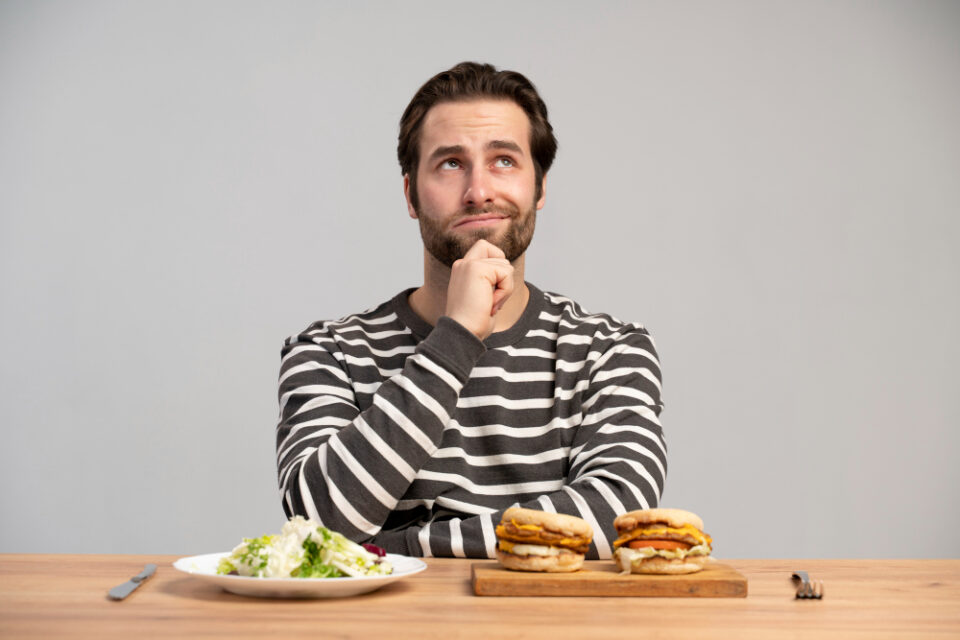
Every clinic day, I know how it will end. No matter what the diagnosis is—migraine, acidity, back pain, piles—the final question arrives like clockwork. The patient leans in, lowers their voice, and asks, “Doctor, what can I eat?” The way they ask it, you’d think I hold the master key to heaven’s kitchen. My degree may say MD, but to my patients, I am MBA: Master of Balanced Appetites.
In India, food is not fuel—it’s faith. One patient once told me, “Doctor, my cholesterol may go up, but if I skip chicken biryani on Sunday, my BP will rise faster.” (And no, there is no such thing as vegetable biryani—it’s called pulao, let’s not insult both rice and chicken.) Another patient said, “I can leave my job, my city, even my wife… but not my filter coffee.” (Priorities are brewed differently in South India.) Doctors write prescriptions, but kitchens write destiny.I once advised a patient with severe acidity to avoid oily food. He came back next week, glowing with pride. “Doctor, I didn’t eat a single oily dish. Only homemade samosas.” As if the stomach runs an Aadhar check before deciding whether to produce acid. A samosa is still a samosa, whether it comes from your wife’s kitchen or from the bakery. The gut has no patriotism.
A woman came to me during mango season. “Doctor, can I eat mangoes while dieting?” she asked, eyes shining with hope. I said, “Yes, in moderation.” She returned a week later, triumphant. “I only had three a day.” For her, moderation was three instead of five. For her pancreas, moderation meant nothing. In Bengaluru, “moderation” is a flexible word, usually defined by the size of the mango.
Ayurveda looks at food differently. We don’t measure calories; we measure qualities. Is the food heavy or light, hot or cooling, oily or dry, nourishing or depleting? Curd at lunch can soothe the gut, but curd at night clogs the sinuses. Bananas calm one patient, constipate another. Tomatoes can reduce inflammation for one person, but worsen joint pain for another. Modern science is busy counting proteins; Ayurveda is quietly asking, “Does this food suit you?”
One retired banker came with arthritis and a list of bans longer than the Constitution: no curd, no brinjal, no pickle, no tamarind, no potatoes, no tomatoes, no life. He looked half-dead already, living on boiled lauki. I asked him what he missed most. He whispered, “Pickle.” I allowed him one spoon a day. His knees didn’t change much, but his smile returned. Sometimes health comes not from removing but from restoring. A small spoon of joy can be the biggest medicine.
A teenager with acne was another victim of food-policing. Her mother had banned oil, nuts, chocolates, and even milk. The poor girl looked more punished than pimpled. I told her, “We’ll work on your digestion and stress first. You can enjoy a little chocolate.” Her skin cleared in months, but more importantly, she stopped looking at every bite as a crime. When guilt leaves the plate, glow enters the face.
Food is also memory. During COVID, one patient had no appetite. Nothing worked—soups, juices, powders. Then her daughter brought her hot curd rice with pickle. She ate, not because of calories, but because it tasted like childhood. Modern neuroscience calls it the gut-brain axis. Ayurveda calls it common sense: food is rasa, the essence of life.
Then there are the classic OPD one-liners.
“Doctor, can I eat dosa?”
“Yes, but not with an oil tank on top.”
“Doctor, chapati is safe, no?”
“Yes, if it’s one or two. Not if it’s twelve.”
“Doctor, what about biryani?”
“Fine—if it’s Sunday lunch. Not a daily breakfast.”
“Doctor, is a banana okay for me?”
“Yes, if you eat one. Not if you run a wholesale business from your plate.”
“Doctor, can I drink juice?”
“Yes, if you squeeze it yourself. Not if it comes in a bottle wearing sunglasses.”
“Doctor, what about coffee?”
“Allowed, if it’s two cups. Not if you treat it like your blood group.”
“Doctor, rice or roti—what’s better?”
“Whichever you eat less of.”
But Google has complicated things. One man asked me, “Doctor, should I drink milk? Some sites call it nectar, others call it poison.” I said, “Drink milk if it suits you. Don’t drink it if it doesn’t.” He stared at me as if I had quoted the Gita in a puzzle. We have forgotten to trust our bodies. Ayurveda teaches: your body is the real laboratory. If milk bloats you, skip it. If it strengthens you, drink it. No website knows your stomach better than your own stomach.
After two lakh patients, I have learned this: food is never just nutrition. It is memory, mood, craving, and culture, all rolled into a chapati. The correct diet is not universal—it is personal. What suits you at 20 may not suit you at 50. What heals in winter may harm in summer. What nourishes during calm may inflame during stress. The best diet is not written on a prescription paper; it is written in your digestion, your energy, and your sleep.
When patients ask me, “Doctor, what can I eat?” they are not asking about food. They are asking for permission to live well. They want to know if health and happiness can coexist. And my answer is: yes, they can. Eat with awareness, eat with joy, eat with balance. Don’t fear your thali—befriend it. The mango is not your enemy; the excess is.
One of my funniest encounters was with a gentleman newly diagnosed with diabetes. He came to me looking very serious, almost funereal. “Doctor, tell me honestly, can I eat sweets or not?” I explained patiently that sweets in excess would worsen his sugars, but a little bit, occasionally, with exercise and control, could be managed. He nodded, very thoughtful. A month later, he returned, beaming. His blood sugar was higher. I asked, “Did you follow the diet?” He said, “Yes, doctor. I only ate sweets occasionally. But because every day is some occasion—neighbour’s birthday, colleague’s promotion, cousin’s engagement—I had to respect the occasion. How can I refuse?”
Another day, the same man came with his wife. She complained, “Doctor, he cuts his gulab jamun into four pieces and says he is eating only one-fourth. Then he eats all four pieces, one by one, calling each a fraction.” I told him, “Sir, your pancreas doesn’t have a calculator. Whether you call it one gulab jamun or four fractions, the sugar is the same.” The whole clinic burst into laughter.
Then his wife delivered the final blow. She said, “Doctor, forget his pancreas. Even our wedding ring has lost its shine—he keeps dipping his finger in the syrup to check the sweetness!” That day, I laughed so hard I nearly wrote “Laughter therapy” as his prescription.
Patients never tire of asking me, “Doctor, what can I eat?” But the truth is, they don’t all mean the same thing. Some come looking for validation—they’ve already decided on biryani and want my stamp of approval. Some murmur the question like a guilty confession, eyes lowered, hoping I’ll say, “Just this once, it’s okay.” Others ask for the sake of asking, like checking a box, knowing very well they’ll ignore the answer. A few have no choice—the cooperation committee at home (read: spouse, mother, or teenage daughter) has forced them into my clinic, and they want ammunition to negotiate dinner. And then some rebels don’t actually want to follow anything; they only want to prove that doctors contradict each other. I’ve learned that for many ( not all), the question “What can I eat?” is rarely about food—it’s about psychology, family politics, even hidden desires.
Once, a diabetic patient asked me earnestly if he could eat sweets. I gave him the standard no. He nodded politely. A week later, I met him at a wedding, stuffing jalebis like a squirrel hoarding nuts. I raised my eyebrows. He grinned sheepishly and said, “Doctor, I didn’t eat them, I only tasted… 27 times.” What can I say? The man had found a loophole in grammar to bypass glucose! In such moments, I don’t know whether to prescribe medicine or applaud creativity.
Every day, patients ask me what they can eat, but very few ask what I eat. Maybe they think doctors survive on fresh air and boiled neem water. So when someone finally asks me, I surprise them. “Doctor, do you eat rice?” Of course I do. “Do you eat pickles?” With great joy. “Do you drink coffee?” Sometimes four cups—especially on Mondays. They stare at me like they’ve just spotted a tiger eating idli at a darshini. Patients often imagine Ayurveda doctors as saints chewing tulsi leaves for breakfast and inhaling prana for dinner. But I’m human, with taste buds, temptations, and yes, sometimes indigestion too.
Which brings me to the old Ayurvedic truth: food is not just about what you eat, but what you digest. Wrong food at the wrong time is poison; simple food with the right emotion can be nectar. I’ve seen people digest heavy festival feasts without trouble because they ate with laughter and company, and others get gas from a single cucumber because they ate it in silence with guilt. The stomach is not a dustbin; it’s a temple, and it listens not just to food, but to feelings.
That’s the truth of food and health in India. We don’t just eat with our mouths—we eat with our culture, our excuses, and our humour. The best medicine is not a bitter pill, but a shared laugh over a sweet mistake.

5 comments
Such a well written article. I think we have all asked you What Should I eat 100s of times. You’ve compiled it so well.
thank you
You have studied your patient’s minds in depth Dr. This article makes me to befriend my thali and be guiltfree. Interesting with humor and educative. Thank you 😊
thank you madam
Dr.the article is so much appreciated for clearing everybody ‘s doubt about what to eat & what not. V want reassurance for what v eat.
But the golden words from ur article is that the company with whom u eat & how well you digest it is very true.. thanks for the realistic expression about food.