
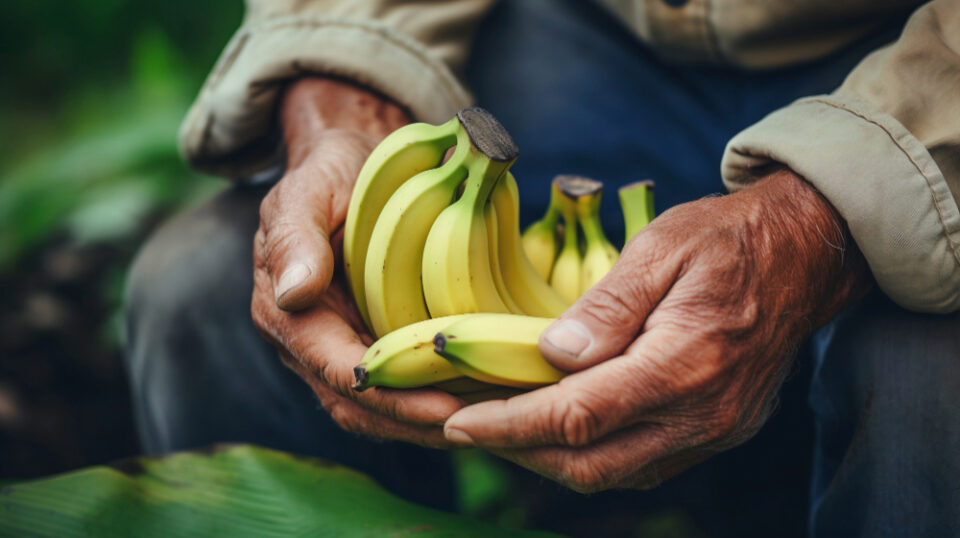
The longer the banana, the happier the man. That was the whole philosophy of my patient, a Cavendish loyalist who for sixty years let no day pass without one, and who judged each the way congregations judge sermons: by length, with open delight when it ran long. Ask him about his sleep, and he answered about ripeness. Ask about his appetite, and he described, like a man reporting a miracle, a bunch he had seen that morning.
What he never knew is that every Cavendish on earth is the same banana. Seedless, sterile, cloned from cuttings across continents, it has no siblings and no backup. Its predecessor, the Gros Michel, was erased by a fungus. He had built sixty years of mornings on a monoculture. Most of us build our lives on weaker things.
Then the heart attack arrived, as it does, without consulting him. He survived with the bewilderment of a man who had always filed bananas under insurance. At home his potassium climbed, and his physician said the sentence: no more bananas.
The physician was right, in the way arithmetic is right. Potassium is the heart’s electrical salt, with thin margins on both sides. Across 38,689 heart-attack patients, the relationship between potassium and mortality was U-shaped, and above 5.5 the death rate passed sixty per cent. The ban was not cruelty. It was cardiology. For most heart patients, a banana is perfectly safe; it was his rising potassium that changed the rule for him.
But a prescription has two readers, the body and the person, and only one of them had been consulted. He asked his wife about the banana. She had a single answer, the doctor’s word, and she gave it faithfully, which is how a loving house becomes an enforcement agency. He grew restless. That night he died in his sleep.
I cannot say the banana restriction caused his death. His damaged heart or high potassium could have been responsible. We do not know. Certainty here would be dishonest.
But I know what medicine knows and rarely says. In 1942, the Harvard physiologist Walter Cannon argued that fear could make a person deteriorate and die within about a day. Decades later, a man diagnosed with metastatic oesophageal cancer died believing he was dying of widespread cancer, as did his family and physicians. At autopsy, only a 2 cm nodule was found in his liver. The most dangerous thing in a doctor’s bag has never been a drug. It is the sentence.
Restriction is a sentence too, only spoken softly. When dialysis patients were interviewed about low-potassium diets, their first theme was a question: “What is left for me to eat now?” My patient asked it all day, in the only language he had, and received the answer a refusal gives.
Charaka, who never owned a laboratory, wrote a better protocol two thousand years ago: withdraw even a harmful habit a quarter at a time, because what the body has grown used to is part of how it holds together. We could have offered half a Cavendish and a repeat blood test. A lower-potassium fruit at the same hour. One question: what will your morning feel like without it? None of that fits on a discharge summary, which is written by people who have never lost a breakfast.
Sixty years is nearly 21,900 mornings. But I think of his wife, who spent his last day and night saying no to the one thing he kept asking for. Next time I restrict a patient’s food, I will give the family a clear plan, including what they can safely offer instead.
