
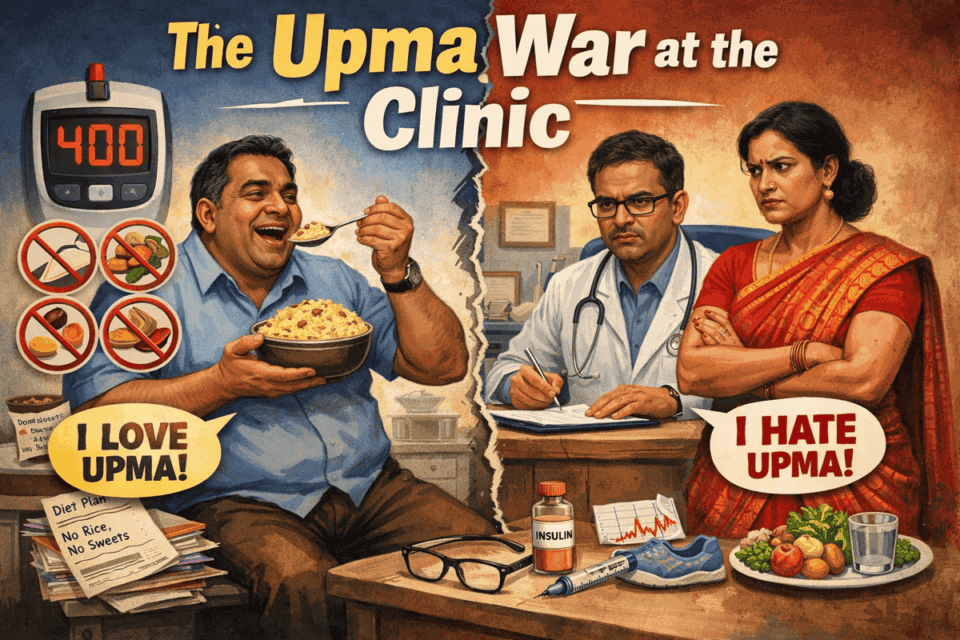
He was fifty. An entrepreneur. The kind who lives on numbers. Revenue, margins, growth curves, projections. He spoke comfortably in percentages and quarterly targets, and when he placed his lab report on my table, he waited for me to admire one more number. Random blood glucose: 400.
He looked calm. Numbers never frighten people who believe they can control them.
I told him to stop eating rice, sweets, and going out to eat, and to stop drinking wine. He nodded with the seriousness of a boardroom decision. One month later, he returned, visibly proud. No rice, doctor. No idli. No dosa. Sweets are almost nil. Wine only socially now. Walking? Yes. Only on days when sleep failed, because the morning after a bad night felt like punishment that deserved exercise. Work remained the same. Work, he said, was non-negotiable.
The glucose remained the same, too.
There are moments in clinical practice when silence teaches more than advice. This was one of them. The body had listened politely and declined to cooperate.
I did not argue with him. I did not repeat instructions. I turned to his wife and asked a question I usually reserve for difficult cases. “What does he eat between meals?”
She did not hesitate. “He eats upma.”
Not once. Not as breakfast. At different times. Outside the three meals. Because it is light. Because it is safe. Because it is not rice.
She said this without irritation. Just clarity.
Then she added, firmly, “I hate upma.”
That sentence told me more than the glucose report.
In my clinic, I have slowly learnt that there are two kinds of people in the world. Upma lovers and upma haters. There is no neutral position. And marriages are often built across this divide, with each side convinced the other is slightly unreasonable. In urban India today, entire diets are organised around such moral categories—foods that feel virtuous, foods that feel guilty, and a few that escape judgement altogether.
Upma is fascinating that way. It looks disciplined. It sounds responsible. It wears the costume of health. Semolina steamed into obedience. It reassures people who want control without discomfort. It is the food equivalent of saying, “I am trying.”
Medically, it is simple. Refined wheat. Fast carbohydrates. Minimal fibre. Easily digested, quickly absorbed, and therefore perfectly capable of pushing blood glucose up, especially when eaten at odd hours by someone already insulin-resistant. But food does not enter lives solely through chemistry. It enters as habit, comfort, and belief.
This man publicly stopped rice and privately embraced upma. He had obeyed the instruction and quietly edited its meaning.
He ran companies where every expense was tracked, audited, and reviewed. But food was managed by emotion. Walking was negotiated with sleep. Wine was reduced, not stopped, because social life needed exceptions. Work was sacred. Metabolism was expected to adjust.
Entrepreneurs are trained to believe that effort automatically converts into outcomes. Biology does not share that optimism.
When I explained semolina, there was genuine surprise. “But it’s not rice,” he said. That sentence again. As if the body recognises ingredients by cultural reputation.
His wife watched silently. She did not need vindication. She had brought evidence. Medicine often fails not because patients hide the truth, but because doctors ask questions that are too polite to uncover it.
Diabetes rarely worsens because patients do not listen. It worsens because they listen selectively. They eliminate what they fear and keep what they love, provided it can be renamed as harmless. Upma, in this story, was not the problem. The problem was the belief that some foods escape physiology because they feel familiar and virtuous.
I asked him to stop the between-meal upma. Not dramatically. Not forever. Just as an experiment. Numbers, after all, respect experiments.
As they left, his wife smiled faintly. The upma war had not ended. But for the first time, it had moved from the kitchen to the clinic.
In medicine, progress often comes not from new drugs but from uncovering the one story patients tell themselves that keeps the disease alive. The most important number that month was not 400. It was the one habit he believed did not count.
Upma was innocent. The myth around it was not.
I have written a book.
If this blog spoke to you, the book will stay with you longer.
.

2 comments
A very nice article. Upma war is real. I’ve been on both sides of it. I’m now on the “for” side of it. I like it.
thank you