
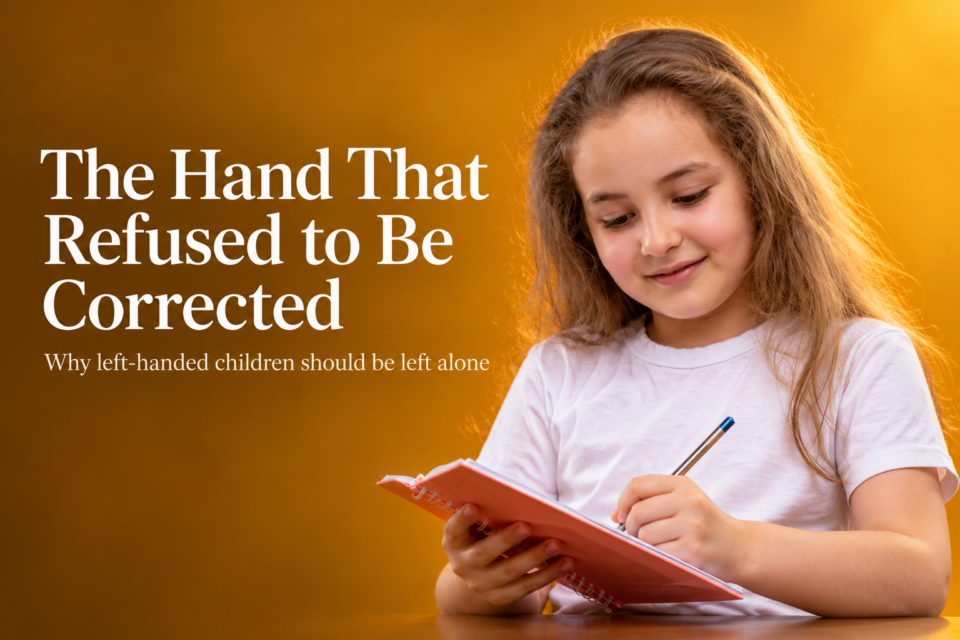
The mother taught at an international school, where children learned to welcome different languages, cultures and ways of life. At home, she was trying to remove one difference with a stick. “Doctor, I hit my daughter every day to make her right-handed,” she told me. “But she still uses her left hand.” Her daughter was eight. I asked the mother to stop hitting her, then asked what she hoped would happen if the child finally obeyed. She wanted the girl to write normally. It was an ordinary wish, except that the girl already did.
About one person in ten favours the left hand, though even this simple number hides a complication: what are we counting? The hand that writes, throws, cuts vegetables or brushes teeth? Sachin Tendulkar writes with his left hand and batted right-handed. His career reminds us that the body does not file all its skills under a single heading. A child who writes left-handed may still use her right hand for other tasks, and none of this calls for correction.
The mother called her daughter’s choice a habit, as if she had acquired it from an unsuitable friend. Yet researchers have observed fetuses repeatedly sucking one thumb rather than the other, and a follow-up study found that this early preference was related to later handedness. No ultrasound can promise which hand a particular child will use for writing, but the finding puts the family argument in perspective: the mother had been trying to discipline a preference that may have begun before they met.
Handedness is shaped by many influences. A study of more than 1.7 million people identified dozens of genetic regions associated with being left-handed, each contributing only a small part. Even identical twins can prefer different hands. That complexity fascinates scientists and frustrates anyone hoping for a simple explanation of why one child in the family reaches left while everyone else reaches right.
What particularly interests me is what happens when adults succeed in making a child switch. The child may write with the right hand, but the original preference hasn’t necessarily vanished; it may have simply become harder to see. Studies have found that switching was far more common among older generations. A naturally left-handed person could grow up signing every document right-handed and, decades later, be counted as a right-hander. The stick had altered the record as well as the handwriting.
That altered record once helped produce a startling medical claim.
Researchers once noticed that fewer elderly people were left-handed than young people. They drew a frightening conclusion: perhaps left-handers died earlier. But many of those older people had grown up when children were forced to write with their right hands. A left-handed child could become an elderly person who answered “right” when asked which hand they used. Some of the supposedly missing left-handers were there all along. We had changed how they wrote, then mistaken the result for how long they lived.
There are happier mistakes to avoid. Tell someone a child is left-handed and Leonardo da Vinci soon enters the room. His surviving notebooks do contain passages written in mirror script, from right to left. That makes Leonardo interesting; it does not make every left-handed child a concealed genius. Nor does the popular claim that left-handers are “right-brained” settle anything. Most left-handed participants in one imaging study still showed predominantly left-sided language activity, though there was more variation than among right-handers. The girl in my clinic needed neither a diagnosis nor an extraordinary destiny.
She might, however, need different scissors. With some right-handed pairs, the blades separate when used in the left hand, so paper folds instead of cutting. A spiral notebook places its binding beneath her wrist; her hand can sweep across fresh ink as she writes. After enough such encounters, a child may become awkward with tasks for which the tools are poorly made. Move the paper, leave space for her elbow and give her scissors that cut. If forming letters remains difficult, help her form letters. Paediatric guidance advises against pressuring a child to choose one hand over the other.
I told the mother plainly that the hitting had to end. We could help her daughter with anything that was genuinely difficult about writing, but using the left hand was not the difficulty. The mother had brought her child to me because the girl would not change. I hoped she would go home understanding how much the girl had already endured to remain herself.

2 comments
Very informative article! Have seen an elderly man who writes and eats with right hand but has stammering speech. He recalls how his mother then forcefully got him into the habit of using right hand though he was a left handed person and that stress made his speech stammering… feel very sorry.
THANK YOU