
A Bengaluru woman ordered a cake and two energy drinks online. The delivery arrived with a complimentary fruit priced at ₹0, the sort of small surprise designed to make a customer feel valued. Her mother ate part of it. The fruit was Datura. Within hours, the free gift had become a medical emergency, the family was in hospital, and Karnataka’s food-safety authorities were asking a question that should have been asked before the parcel left the warehouse: how did one of India’s best-known poisonous plants enter a grocery bag?
The investigation reportedly found Datura fruits or seeds listed or distributed through Amazon, Swiggy Instamart and BigBasket. Karnataka’s Food Safety and Drugs Administration suspended their food licences until further orders and directed them to remove related listings, advertisements and sales intended for food or human consumption. This was not a blanket ban on the Datura plant, its ritual use or its controlled presence in licensed traditional medicines. The government was making a much simpler point: a sacred object may be sold for worship, a seed may be supplied for cultivation and a poisonous medicinal ingredient may move through a regulated pharmaceutical chain, but none of them should arrive beside cake pretending to be food. The Economic Times, The Times of India
Naturally, people wanted to know why these companies were selling Datura at all. The answer is not yet fully public. Datura has legitimate non-food markets in India. Its flowers, leaves and thorny fruits are offered to Shiva, especially during Shravan and Mahashivratri. Its seeds may be sought for cultivation, botanical collections or research. Authenticated plant material may also be procured by licensed Ayurvedic, Siddha and Unani manufacturers under strict controls. Less safely, the plant attracts buyers interested in occult practices, reckless home remedies or hallucinations. What investigators have not yet disclosed is crucial: who supplied the Datura in this case, where it was sourced, how it was described, under which category it was approved, who handled it and why it allegedly travelled through a food-licensed delivery chain.
That distinction protects us from an easy but lazy conclusion. The platforms may not have grown the plant or intended anyone to eat it. Third-party sellers may have uploaded the listings, and a product intended for ritual use may have been misclassified. But a marketplace stops being a passive noticeboard when it categorises, advertises, stores, recommends or delivers a product. Between seller registration and a customer’s doorstep stand several opportunities to ask whether an item is edible. Somehow, a plant recognised instantly by a flower seller outside a Shiva temple appears to have passed through modern catalogue systems without anybody—or anything—understanding what it was.
Ayurveda understood the difference. Dhattura was never an ancient superfood, although the internet can convert almost anything with a Sanskrit name into one before breakfast. Later Ayurvedic toxicological and pharmaceutical literature placed it among potent poisonous substances requiring specialised handling, processing, tiny doses and medical supervision. Modern Indian regulation is equally direct: Datura metel is listed under Schedule E(1) of the Drugs and Cosmetics Rules as a poisonous substance used in Ayurvedic, Siddha and Unani medicines. Its presence in a pharmacopoeia no more makes it food than morphine’s presence in a hospital makes it a beverage.
Even its traditional names carry caution. Dhattura has been called Kanaka, “the golden one,” a name as beautiful as its trumpet-shaped flower. Other associations link it with unmatta—madness or derangement. Our ancestors did not market it as Calm Mind Seed, Himalayan Detox Fruit or Shiva’s Secret Metabolism Booster. They gave its danger a name and placed boundaries around its use. The poetry was attractive; the warning was not optional.
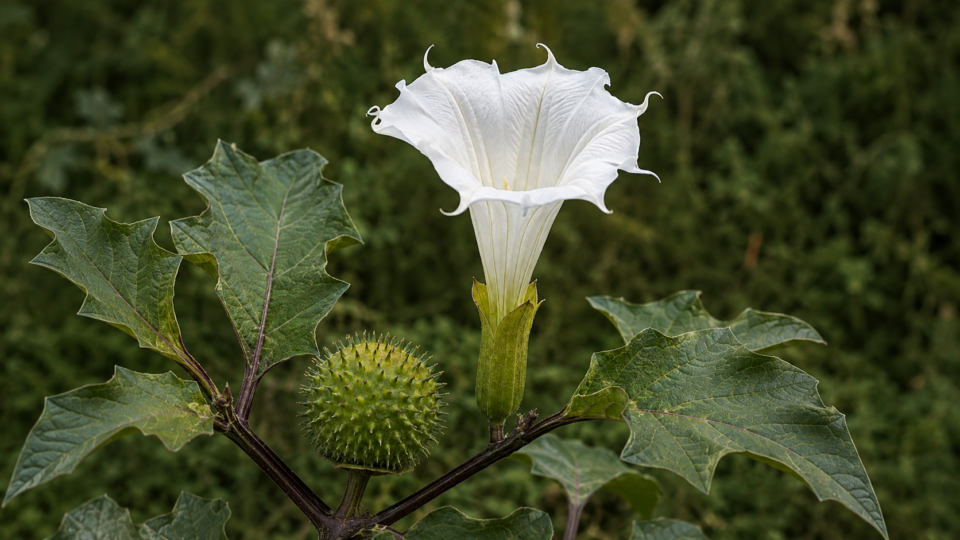
The fruit itself looks like something designed to discourage appetite. It is a green capsule armed with spikes, as though nature prepared it for combat and was surprised to find it in a shopping cart. Every part of the plant may contain tropane alkaloids, principally atropine, hyoscyamine and scopolamine. These substances block muscarinic acetylcholine receptors, disrupting the nervous system’s control over sweating, salivation, pupils, heartbeat, bladder, intestines, attention and memory. In plain English, Datura can make the mouth go dry, the skin hot, the pupils enormous and the heart behave as though it has received terrible news.
As poisoning deepens, confusion can become delirium. People may speak to persons who are not there, fight imaginary enemies, fail to recognise relatives or attempt to escape from the very hospital trying to save them. Seizures, coma and death are possible. Toxicologists sometimes describe the classic anticholinergic patient as dry, hot, blind, red and mad—a memorable rhyme until the patient is somebody’s mother. PubMed
There is no dependable household dose because Datura refuses to be standardised by guesswork. Alkaloid concentrations vary between species, individual plants, plant parts, seasons and growing conditions. Ten seeds from one pod need not behave like ten from another. This is why “take only a little” is not traditional wisdom, modern medicine or sensible experimentation. It is Russian roulette conducted with a thorny fruit.
The world learned this lesson spectacularly in 1676. British soldiers stationed in Jamestown, Virginia, reportedly ate boiled leaves of a related Datura species in a meal. What followed was not one of the British Army’s more disciplined campaigns. Historical accounts describe prolonged delirium, foolish behaviour and temporary madness. “Jamestown weed” was eventually shortened to “jimsonweed,” leaving the English language with a botanical name born from a military lunch that went badly wrong. More than three centuries later, Bengaluru repeated the central error with better logistics: something poisonous entered a meal because nobody identified it before it was served.
Datura’s medical history is equally astonishing. Indian practitioners once used carefully prepared smoke from Datura species in selected cases of severe breathlessness. British doctors encountered the practice in India around the beginning of the nineteenth century and carried it to Europe. Soon, Victorian pharmacies were selling stramonium powders, pipes and “asthma cigarettes.” Medicine had decided to treat difficulty in breathing with smoke, proving that every century possesses at least one idea it delivers with great confidence and later hides in a cupboard.
The remedy was not entirely foolish. Datura’s antimuscarinic alkaloids could temporarily relax constricted airways, a pharmacological ancestor of certain modern bronchodilators. But the natural product delivered an unpredictable dose, poisoning occurred, and repeated smoke damaged the lungs. As safer inhaled medicines arrived, Datura cigarettes moved from pharmacy shelves into medical museums, where they remain fascinating, instructive and unsuitable for home delivery. National Library of Medicine
This history neither proves that Datura is safe nor discredits Ayurveda. Powerful medicines often live close to poison. Digoxin can steady a failing heart and also dangerously disturb its rhythm. Anaesthetic drugs can abolish pain and suppress breathing. Chemotherapy can kill cancer cells while injuring healthy ones. The difference between medicine and poison is not a flattering description on a product page. It is correct identity, proper preparation, controlled dose, genuine indication, quality assurance and competent supervision.
Ayurvedic Shodhana must also be understood honestly. It is not a domestic cleansing trick that converts a poisonous seed into a safe kitchen remedy. Traditional pharmaceutical authorities describe specialised processing methods, and researchers continue to examine how such procedures alter chemical constituents. But purification is only one part of safety; authentication, standardisation, dosage and prescribing remain essential. Nobody should soak Datura after watching a video, grind it according to an anonymous post or inhale its smoke because an ancient physician once used a related preparation. A classical reference is not a licence for amateur toxicology.
Its association with Shiva makes the confusion more poignant. During worship, the Datura flower or fruit does not become prasad merely by standing near the deity; it carries symbolic meaning. Temple culture preserves such distinctions through living memory. A flower vendor knows which part is offered, a priest knows where it belongs, and families warn children not to put the fruit in their mouths. The system may possess no barcode, compliance dashboard or artificial intelligence, yet its most important information survives: this is sacred, this is powerful, and this is not dinner.
That is why the Bengaluru incident is larger than one poisonous fruit. Civilisations once stored dangerous knowledge in trained people—in physicians, pharmacists, priests, gardeners, vendors and grandmothers. Digital commerce stores products in categories. Categories can move millions of items at astonishing speed, but they understand nothing unless human knowledge has been carefully built into them. If “ritual flower,” “medicinal raw material,” “garden seed,” and “food” collapse into a single searchable inventory, convenience becomes ignorance with a delivery partner.
Somewhere in a Bengaluru hospital, a family waited for a woman’s mind and body to return to them. Elsewhere, three enormous companies discovered what Ayurveda, toxicology and the flower seller outside a Shiva temple already knew. Datura may be worshipped, studied and, under rigorous controls, used medicinally. It must never be mistaken for food. For centuries, people survived this beautiful plant because somebody remembered what it was. Then knowledge was replaced by a product category, and poison arrived at a family’s door marked ₹0.
