
At 5:15 in the evening, one software engineer sat in front of me breathing like a man escaping from a building fire. Nothing was burning. He had merely opened Outlook.
“Doctor, I think I have anxiety.”
“How long?”
“Three years.”
“What happened three years ago?”
“Promotion.”
Modern civilisation can probably be summarised in that conversation. Earlier generations developed back pain carrying sacks of rice. This generation develops sympathetic overdrive in response to calendar notifications.
I asked him to take one deep breath. He inhaled dramatically through his mouth. “There,” I said. “That is your problem.”
He looked mildly offended. Most people do when a doctor diagnoses their breathing before checking vitamin D, thyroid profile, liver enzymes, HbA1c, ferritin, lipid profile, uric acid, testosterone, CRP, ESR and occasionally horoscope compatibility.
The strange thing about breathing is that everyone assumes they know how to do it, even though, technically, they are still alive. This is like saying you are an expert at relationships because your marriage has not yet required police intervention.
Ancient yogis would have found modern breathing deeply alarming. Entire cities now breathe through the mouth, shallowly, rapidly, anxiously, while staring at glowing rectangles at midnight under artificial light with one nostril blocked by stress, pollution, sinusitis, or EMI pressure.
The nose, poor fellow, has been reduced from a sophisticated neurological instrument into mere face furniture. Which is unfortunate. The nose is not a pipe. It is a neurochemical laboratory.
Within the nasal passages and sinuses, humans produce nitric oxide, one of the most important signalling molecules in physiology. Nitric oxide helps regulate blood vessel dilation, improves oxygen exchange in the lungs, influences immunity, and even affects circulation inside the brain. Nasal breathing quietly enriches incoming air with this molecule before it reaches the lungs.
Mouth breathing bypasses the entire mechanism, like a student bunking a practical class and writing the final exam directly.
Ancient pranayama practitioners obviously did not know the phrase “nitric oxide.” They simply observed something that modern neuroscience is rediscovering with expensive machines and very serious conference presentations: the body behaves very differently when air enters the body slowly through the nose.
One fascinating modern study found that experienced practitioners slowing respiration to around 2.5 breaths per minute developed altered connectivity involving theta brain waves, neurological states associated with meditation, creativity, memory consolidation, and that strange half-awake condition where the brain suddenly remembers humiliating incidents from 2011.
Mouth breathing at the same respiratory rate did not produce similar effects. The route mattered.
That is the part most people miss. Breathing is not merely oxygen transport. It is neural behaviour. Every emotion carries its own breathing pattern, like background music in a cinema.
Watch an angry man. Rapid upper chest breathing. Watch a frightened child. Breath frozen. Watch somebody crying after terrible news. Broken exhalations. Watch a corporate employee replying to emails at 11:47 PM saying, “No problem, noted.” Tiny, fragmented breaths. Neck tight. Jaw clenched. The nervous system behaves as if a leopard may enter through the balcony.
In clinical practice, I have noticed something curious. Many anxious patients do not have inhalation problems. They are exhalation problems.
Somewhere along the way in modern life, people forgot how to fully exhale. The nervous system remains permanently half prepared for danger. Evolution designed this response for wild animals and genuine emergencies. Urban Indians now use it for WhatsApp groups, traffic diversions, annual appraisals and relatives asking, “So what are your future plans?”
This is where pranayama becomes extraordinary. Especially exhalation. During prolonged exhalation, heart rate subtly slows, vagal pathways are activated, muscles relax their microscopic grip, and the body receives an ancient biological message: immediate danger appears reduced. One slow exhalation is not spirituality. It is neurophysiology.
The vagus nerve has recently become fashionable on wellness podcasts hosted by muscular men sitting in ice baths. Yogic traditions have been influencing vagal tone for centuries through chanting, humming, alternate nostril breathing, prolonged exhalation, and rhythmic respiration.
Even sighing has science behind it. Researchers now know spontaneous sighing helps reset lung mechanics and emotional regulation. The body occasionally forces a sigh as the nervous system recalibrates.
One businessman told me, “Doctor, I feel exhausted by evening, though all reports are normal.” I asked him one question.
“When was the last time you walked for twenty minutes without your phone?” He stared at me as if I had asked when he last harvested wheat manually.
Modern urban breathing has become biologically strange. People sit collapsed for ten hours, diaphragm compressed, shoulders elevated, jaw tightened, chest barely moving. Air enters only enough to maintain shareholder value.
Then suddenly the gym begins. The same person surviving on caffeine, stress hormones, airport sandwiches, and 4 hours of sleep is expected to perform high-intensity interval training at 6 AM, with motivational music playing in the background.
The diaphragm must be one of the most insulted muscles in modern civilisation. Most people think breathing happens only in the lungs. In reality, the diaphragm influences posture, circulation, lymphatic movement, abdominal pressure, digestion and even emotional regulation. Fear tightens it. Relief softens it. Grief destabilises its rhythm. Many people have not taken a fully relaxed breath in years.
This is partly why anxiety patients frequently arrive carrying acidity, bloating, constipation, IBS, neck pain, palpitations, fatigue and insomnia together like relatives attending a wedding in one vehicle.
The body is not divided into separate departments. Gastroenterology downstairs. Psychiatry upstairs. Cardiology is slightly left. The body is one continuous conversation. Pranayama entered that conversation thousands of years ago with astonishing sophistication.
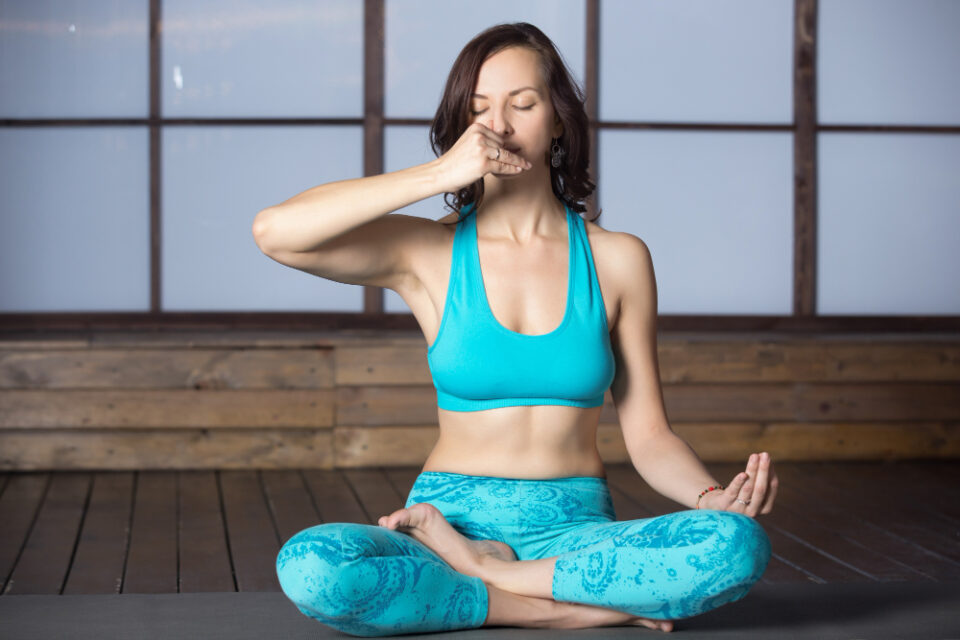
Take alternate nostril breathing. Many dismiss it as a retirement hobby conducted by disciplined uncles in white clothes near public parks. Yet modern studies suggest nasal dominance may influence autonomic balance between sympathetic activation and parasympathetic calming. Left nostril practices often reduce arousal. Right nostril stimulation may increase alertness.
Then comes carbon dioxide, perhaps the most misunderstood molecule in respiratory physiology.
Poor carbon dioxide has terrible public relations. Everybody treats it like biological garbage requiring immediate evacuation. In reality, the body uses carbon dioxide intelligently. Oxygen does not leave haemoglobin and enter tissues simply because it feels emotionally generous that day. Carbon dioxide helps haemoglobin release oxygen where tissues actually need it. This is part of the Bohr effect, one of the most elegant mechanisms in physiology. Which creates a strange paradox. People who breathe too rapidly may deliver oxygen less efficiently, even though they breathe more. Some panic attacks are partly physiological, masquerading as a catastrophe.
Ancient breath-retention practices suddenly begin to look less mystical and more biologically interesting. A calm human being breathes differently.
Watch a sleeping child. Watch an old farmer sitting silently outside after the rain. Watch somebody praying quietly after everybody leaves the temple. The breath slows naturally whenever the nervous system feels unthreatened. Perhaps peace was never entirely psychological. Perhaps it was respiratory.
One young patient with severe insomnia told me proudly that he listened to productivity podcasts till 2 AM every night. “Relaxing podcasts?” I asked. “No doctor. Hustle mindset.” Even his relaxation had performance anxiety.
I taught him simple, slow nasal breathing with prolonged exhalation before sleep. Just slow breathing in the darkness without screen exposure. Two weeks later, he said something interesting.
“My thoughts are still there, doctor. But they are no longer running.”
That may be the most accurate description of pranayama I have heard from a patient.
Thought itself appears to have a respiratory rhythm attached to it. This may explain why chanting, singing, prayer, bhajans, mantras, poetry recitation, and meditative rituals across cultures repeatedly involve controlled breathing patterns. Human civilisation may have discovered nervous system regulation accidentally through devotion long before neuroscience existed.
Ancient yogis may never have heard of nitric oxide, the vagus nerve, or carbon dioxide tolerance. They simply discovered something modern neuroscience is slowly relearning: The mind changes when breathing changes.
Behavioural neurology disguised as breathing.
I have written a book.
If this blog spoke to you, the book will stay with you longer.
