
She had done everything right. That was the problem. She walked every morning. She slept seven hours. She had not touched a piece of bakery in three years, not a single biscuit, not even on the occasions when the entire family was having biscuits. She was a retired professor of mathematics, 65 years old, and she had applied the same rigorous logic to her health that she had once applied to theorems—systematically, without sentimentality, without room for error. Her blood reports should have been clear proof. They were not.
Triglycerides: 350. LDL: 185.
Three years of statins. Still this.
She placed the reports on my table the way one submits a theorem for peer review — complete, confident, and waiting, with great patience, for me to explain what the mathematics could not.
I became an investigator. Exercise, I asked. She walked daily and did light yoga when she felt like it. Oily food? None. Non-vegetarian? No eggs, no fish, nothing. Bakery? Not in three years, as previously established. Chaat? No. Curd at night? No. Coffee? No. Sweets? Only on Janmashtami—and on Janmashtami, she specified —only the traditional ones, only the correct amount. Seven hours of sleep. Days full of reading, household work, and meeting friends. A life arranged on paper with almost military precision. I ran out of questions the way an overconfident army runs out of ammunition — in a volley that started impressively and ended in embarrassing silence. Then I asked the only question I had not asked.
How do you eat?
A pause arrived. Not long. Just enough for the truth to adjust its clothing before entering the room. Dosa, she said, three times a week. With a full block of butter placed on the surface while it was still hot, still crackling, still making that sound that every South Indian kitchen has used for centuries as its particular signature of love. And every afternoon with rice — first the ghee, two generous teaspoons, golden and unhurried, then dal, then rasam, then curd rice. In that order. As her grandmother taught. As her mother taught. As every properly run South Indian household insists, it is not merely a preference but the correct grammar of a civilised meal. Non-negotiable. Self-evident. Obvious to anyone raised properly.
Doctor, we are followers of Lord Krishna. When our God ate butter and ghee, why can’t we? Professor of Mathematics, age 65, triglycerides 350
She said it the way she must have once corrected a student who had arrived at the wrong answer through entirely confident work—not unkindly, but with the certainty of someone who has checked the proof twice and found it sound. She was not wrong about the tradition. She was not wrong about Krishna. She was wrong about the geography, but with great devotion and excellent intentions.
Krishna ate butter in Gokul. He stole it from neighbours, hid it from his mother, consumed it with the joyful shamelessness of a boy who had been running barefoot through forests since before sunrise, climbing trees, wrestling cousins, dancing through the night, burning through energy the way only a divine cowherd with no cholesterol panel and excellent genetics possibly can. By the time he arrived in Dwarka — statesman, king, charioteer in the most catastrophic war in human history, a man who spent his days in courts and councils and long strategic conversations — the ancient texts quietly stop mentioning the butter. Not because the texts forget. Because life had changed. The context had changed. The body making the demands had changed. Krishna, one suspects, understood portion and purpose rather better than the Instagram accounts currently quoting him do.
She burst into laughter. The genuine kind, the kind that reorganises a face entirely. And that is where the real conversation began.
* * *
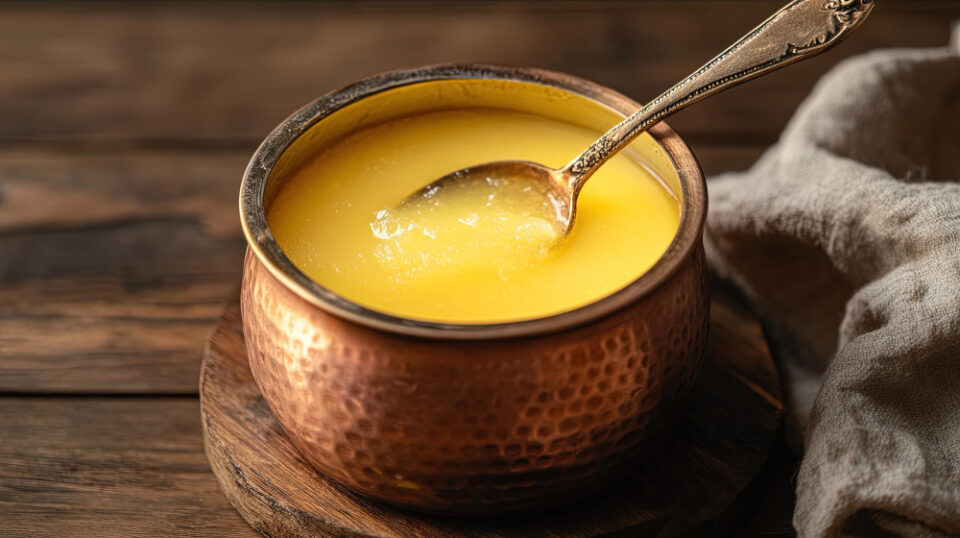
Before we talk about what ghee does to your cholesterol, it is worth knowing what ghee is — not in the kitchen sense, which every Indian already knows, but in the historical sense, which almost nobody does, and which changes the conversation entirely.
Five thousand years ago, a priest stood before a yajna fire and poured ghee into the flames slowly, deliberately, watching it catch light and rise as fragrant smoke toward a sky that felt, in that moment, negotiable. The Rigveda, composed between 1500 and 1200 BCE—older than Homer and among the earliest surviving bodies of human thought—does not treat ghee merely as food. It treats it as a medium of communication between humans and gods. Ghrita, it calls it. The word appears in those hymns with the reverence we now reserve for breakthrough medications. It was currency. It was a preservative —sealed pots of ghee travelled the Silk Road from the subcontinent to Central Asia and arrived intact, unspoiled, months later, in a world without refrigeration and desperately in need of solutions. The Charaka Samhita, the oldest surviving medical textbook on earth — older than Hippocrates, the Greek gentleman whom Western medicine calls its father — calls ghee medhya, nourishing to the intellect, and hridya, beneficial to the heart. It describes ghee as an anupana, a carrier that escorts medicines deeper into the tissue, the way a knowledgeable guide escorts a tourist past the parts of the city they would otherwise miss.
A substance that has survived five thousand years of human opinion deserves more than a single anxious blood report to condemn it. But five thousand years of survival is not the same as five thousand years of unlimited permission. And this is precisely where the story gets interesting.
* * *
In 1869, the Emperor Napoleon III of France offered a prize — actual prize money, government-backed — to any chemist who could invent a cheap, stable substitute for butter. His armies needed fat that wouldn’t spoil on long marches. The urban poor needed something they could afford. A French chemist, Hippolyte Mège-Mouriès, won the prize for a pale, waxy, spreadable product made initially from beef tallow. He called it margarine. Nobody at the prize ceremony worried about what would happen a century later when governments across the developed world, alarmed by rising heart disease, would instruct their populations to abandon butter — which had existed for millennia — and eat this industrially produced substitute instead. The populations, trusting, obedient, genuinely trying to be healthy, listened. They spread margarine on their toast for decades. Cardiovascular disease continued its rise. It emerged, eventually, that the hydrogenated margarine being sold in those cheerful yellow tubs contained trans fats — artificially created fatty acids that the human body had never encountered in its evolutionary history and had absolutely no mechanism for handling gracefully. Trans fats, it turned out, raised LDL and simultaneously lowered HDL, the good cholesterol, a combination so metabolically destructive that even the most defensive food industry researcher could not argue with the data for long. The margarine was more dangerous than the butter it replaced. Humanity had conducted a 100-year experiment on itself at scale and gotten the answer completely backwards. The butter was not the problem. Finding the actual problem proved considerably harder.
In 1961, a persuasive American physiologist named Ancel Keys appeared on the cover of Time magazine — the very register we are aiming for in this piece, which is either irony or symmetry depending on your appetite for coincidence — and announced that dietary fat caused heart disease. His Seven Countries Study became the foundation for governments’ nutritional policy for half a century. What was disclosed more quietly, by researchers who came later and asked harder questions, was that Keys had gathered data from twenty-two countries. He had published seven. The fifteen he omitted — France, Switzerland, West Germany among them — tended to contradict his thesis in uncomfortable ways. France, in particular, was an embarrassment to the hypothesis: the French ate more saturated fat per person than almost any developed nation and had some of the lowest rates of cardiovascular disease in the world. Researchers named it the French Paradox, wrote papers about it, proposed wine as the explanation, proposed meal pace, proposed food quality, and never fully resolved it. Decades later, it remains open. The French, for their part, have continued eating their butter, cheese, and crème fraîche and outliving the theory.
I told my professor this. She leaned forward slightly, in the way that mathematicians lean forward when they sense an error in a proof they had previously trusted. So the science was wrong, she said. Not wrong, I told her. Incomplete. Which is a different thing, and a more interesting one. Wrong means start over. Incomplete means keep going, look harder, and ask the questions that weren’t asked the first time.
* * *
Here is what the kept-going, looked-harder science has found, and what almost no dining table argument in India includes because it is genuinely new and genuinely surprising.
Not all LDL tells the same story. This is where lipid science in the last two decades has become genuinely interesting and genuinely complicated. LDL particles come in different sizes — large and buoyant, small and dense. Small dense LDL particles are associated with higher cardiovascular risk — smaller, more likely to penetrate arterial walls, more prone to oxidation, more likely to accumulate where plaques begin. HealthCentral Here is what surprises most people: saturated fat, from ghee and butter, tends to raise the large buoyant variety Springer — the relatively less dangerous kind. Refined carbohydrates — white rice, maida, sugar — raise triglycerides, and high triglycerides in the bloodstream drive production of small, dense particles, the dangerous kind. The relationship is not direct, but it is real and well-documented. The current frontier of cardiology goes further still, arguing that what matters most is not particle size at all but total particle number — the ApoB count, a measure most Indian blood reports do not even include. The science is still arguing with itself, which is what good science does. What is not in dispute is this: the story is more complicated than one spoon of ghee in one silver bowl, and the rice underneath it may be carrying more of the burden than the ghee on top.
There is more. Ghee is one of the richest dietary sources of butyrate — a short-chain fatty acid that does something remarkable and almost entirely unmentioned in popular cholesterol discussions. Butyrate is the primary fuel for the cells lining the gut wall. It maintains intestinal barrier integrity, reduces gut inflammation, and has demonstrated genuine anti-cancer properties in peer-reviewed laboratory studies. This is the biological mechanism underneath Ayurveda’s ancient claim that ghee supports digestion. Not mysticism. Not tradition asserting itself against evidence. A specific molecule doing a specific job in a specific tissue, documented, reproducible, and real. When your mother said ghee is good for the stomach, she was correct. She simply did not have the vocabulary for “butyrate,” and the vocabulary does not make the fact any truer than it already was.
One more thing, and this one changes what happens in your kitchen every morning. Ghee has a smoke point of approximately 250 degrees Celsius. This matters because when cooking oils are heated beyond their smoke point, they oxidise and break down into aldehydes — volatile compounds with genuine toxicity, implicated in cellular damage and inflammation. Refined sunflower oil, which millions of Indian households switched to from ghee in the belief that they were making the heart-healthy choice, has a smoke point considerably lower than ghee when used for high-heat cooking like tadka or frying. The oil that seems safer may, at high temperatures, produce compounds that ghee would not. The thing everyone is afraid of turns out to be more stable over a hot flame than the thing they switched to out of fear. This is not an argument to pour ghee freely. It is an argument for precision over panic.
Every Indian family has an uncle. You know this uncle. He is usually the oldest surviving male, the one with the magnificent moustache and the particular chair that is his and only his, the one who has eaten ghee every single day of his seventy-eight or eighty-four or ninety-one years without once consulting a cardiologist, whose blood reports — when someone finally makes him take one — are so clean they produce a silence in the room followed by argument. This uncle is trotted out at full volume in every cholesterol discussion as the definitive rebuttal to modern medicine’s concerns. He sits there in his chair, alive and inconvenient, a one-man clinical trial with a sample size of one and results that cannot be replicated.
The uncle is real. His excellent health is real. His genes, however, are not available for distribution, and this part of the argument is quietly omitted. Genetic variants in the apolipoprotein E gene — APOE, if you want the vocabulary — determine in significant part how efficiently an individual processes dietary saturated fat. Some people carry variants that handle saturated fat with cheerful metabolic efficiency, converting it, using it, and moving it along without incident. Others carry variants that make saturated fat a genuine hazard, spiking LDL in response to quantities that would go unnoticed by the first group. You cannot choose your APOE variant. You did not get to choose your uncle’s either. He is an anecdote wearing the costume of evidence. He is wonderful. He is statistically irrelevant to your specific situation. Cherish him anyway.
* * *
Ayurveda, it turns out, already knew that the uncle was not a universal prescription. This is the part of the classical tradition that the internet has systematically lost. The Charaka Samhita praises ghee with genuine warmth — and then, in the same texts, specifies clearly that ghee is contraindicated in obesity, in the condition called ama, which maps uncomfortably well onto what modern medicine now calls metabolic syndrome, in kapha excess, in certain seasons, in certain constitutions. The matra — the dose — is not a footnote in classical Ayurveda. It is a governing principle, a chapter, a recurring insistence. Pathya — the appropriate context for any substance — is as important as the substance itself. The same system that elevated ghee to sacred status also built in, with great specificity, the conditions under which that elevation should be suspended. Instagram remembered the elevation. It forgot the conditions entirely. It has been quoting Ayurveda the way a student quotes a textbook — selectively, in service of the conclusion already desired.
Modern medicine says: risk depends on LDL, diabetes, weight, genetics, lifestyle, particle size, inflammation, sleep, and stress. Ayurveda says: suitability depends on agni, prakriti, vaya, vyadhi, matra — on digestive fire, constitution, age, disease state, and dose. These are not opposing philosophies. They are different languages describing the same house from different windows. You do not need to choose between them. Please open both windows and let the cross-breeze circulate.
* * *
I did not ask my professor to renounce ghee. I did not suggest that her grandmother’s kitchen was ignorant, that wearing a sari was wrong, or that Lord Krishna’s dietary choices were theologically unsound. I told her what I have told you—that context is the variable everyone leaves out of the equation. That a cowherd’s body in Vrindavan and a retired professor’s body in a well-appointed apartment involve caloric arithmetic so different they might as well belong to different species. That two teaspoons of ghee daily, plus a full butter block on the dosa, in a body already carrying excess weight, already metabolically stressed, already showing these numbers in these reports, is more than this particular system can quietly absorb and continue pretending everything is fine. That she could keep her ghee — honoured, present, real — but measured. That the butter block on the dosa was a generosity the dosa did not actually require to taste like itself. That we would adjust the meal pattern, increase walking, and reduce the refined-carbohydrate load, which I suspected was doing more damage than the ghee had been blamed for.
She listened. She argued, which is the correct response of a mathematician confronting a proof she finds inconvenient but cannot disprove. She asked whether I was certain. I told her I was certain about the direction and honest about the complexity, which is the most any physician can offer and more than most patients want.
She came back three months later. Triglycerides at 212. LDL is moving toward acceptable. Not perfect. But moving, which in medicine is sometimes the closest thing to perfect that is available. She sat down in the same chair, placed the new reports on the desk with the same precision, and said — with the quiet satisfaction of someone who has finally located the error in a calculation that had been troubling her for months — Doctor, the dosa still tastes the same.
Of course it does. The dosa was never the problem. The dosa was never going to be the problem. The dosa is five thousand years old and has survived British colonialism, partition, globalisation, and the invention of the air fryer. It will survive us both.
Ghee is not a villain. It is not a visa to immortality.
It is a potent food carrying five thousand years of human ingenuity,
the prayers of priests, the laughter of a cowherd boy,
and the careful instructions of physicians who knew, long before we did,
that the dose makes the poison and the wisdom makes the dose.
Proportion is not the enemy of tradition.
It is what tradition always meant, before we forgot to read the whole book.
I have written a book.
If this blog spoke to you, the book will stay with you longer.

2 comments
You have made a voluminous effort to clarify with profund science and logic, the myth of ‘clarified butter’ as English couldn’t spell Ghrita appropriately. BTW ‘Ghee’ is Hinglish than otherwise thought. Hats Off to your wisdom of analytics Dr. Brahmanand. 🫡 It was a perfect classroom experience for me. Thanks a million! Need to make a big noice about this matter on media for the benefit of ignorant, modern/western acculturated Indians if not for the world. Very proud of you. Keep up. 👍
Thank you so much for this incredibly kind and insightful comment! Your point about Ghrita vs “Ghee” being Hinglish is a gem, so true and often overlooked! The world needs more curious minds like yours who dig deeper beyond surface labels. Let’s absolutely make that big noise together; our ancestors’ wisdom deserves a global stage! Thank you Sir