
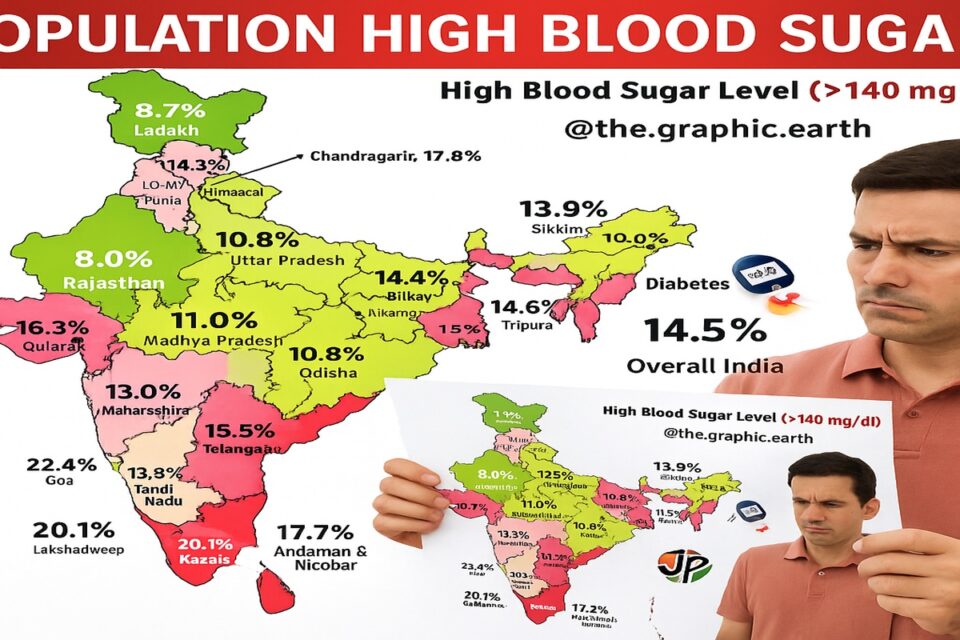
A man barged into my clinic waving a map of India, and in that instant, I knew the country had finally found something sweeter than gossip—its rising blood sugar. “Doctor, look! India is drowning in sugar!” he declared with the urgency of someone announcing a cyclone. I took one glance at the map and felt as though our states were sitting in a diabetic classroom—Kerala and Tamil Nadu scoring distinctions, Gujarat and Telangana chasing them bravely, and poor Rajasthan scoring a rare 8% as if it were following a secret diet the rest of us never got invited to. Maps can be cruel; they show us truths we pretend not to see.
Karnataka stared back at me with 14.8%—not the worst, not the best, just the classic middle-bench student who occasionally gets scolded but still survives the parent-teacher meeting. And yet, this “average” number hides a truth I see daily: urban Karnataka is running almost 1 out of 5 adults into prediabetes territory. Bengaluru alone behaves like a metabolic pressure cooker—late-night coding, Swiggy lifestyles, sleep debt that could crash a server, and chai that flows like municipal water. In my OPD, I rarely treat diseases; I treat the consequences of adulthood. Every city has its addictions, but Bengaluru’s is glucose with Wi-Fi.
Last week, a techie entered my clinic wearing guilt like a backpack. “Doctor, my sugar is 240… but I only eat two biscuits with tea.” When I asked their size, he stretched his hands wide like a fisherman explaining a legendary catch. High blood sugar isn’t built on sweets alone; it is built on denial, packaging, and portions that grow faster than salaries. Even the most advanced glucometer cannot measure the sugar hidden in justifications.
I’ve practised for 25 years, and one truth keeps returning like an uninvited WhatsApp forward: diabetes doesn’t arrive alone—it brings lifestyle as co-accused. Poor sleep spikes insulin resistance. Chronic stress releases cortisol that behaves like internal sabotage. Late dinners ensure the pancreas works through the night. Ayurveda wrote this long ago: ajirna, ati bhojana, ratribhojana, manasika vyadhi—digestion disturbed, overeating, late-night meals, mental distress.
One of my patients, a 52-year-old professor from Basavanagudi, once told me, “Doctor, my sugar is high because I overthink.” He wasn’t entirely wrong. Studies from Harvard and The Lancet now show that chronic worry and long-term stress raise inflammatory markers, disturb insulin signalling, and worsen blood sugar. Ayurveda said this in a single line with disarming simplicity: chinta causes vyadhi.
Another day, a Kannadiga banker confidently told me, “I have switched from sugar to jaggery. I’m safe.” Jaggery is still sugar, wearing a more traditional kurta. The body doesn’t reward cultural sentiment. Chemistry doesn’t bend for nostalgia. Even Google can’t help people who believe replacing sugar with jaggery is a spiritual upgrade. Hope is good, but hope with wrong information is a sweet trap.
The funniest moment came when a young woman proudly said, “Doctor, I walk 7,000 steps daily!” I asked what she ate afterwards. “Just light food… ragi dosa, kesaribath, and little Mysore pak.” In Karnataka, “light food” is an emotion, not a calorie count. Our tongue lies. Our pancreas does the bookkeeping.
Karnataka has one more silent player in this story—hereditary risk. Studies show South Indians have poorer beta-cell reserves compared to North Indians, meaning our pancreas tyres faster. Add polished rice, irregular meals, and stressful jobs, and we create the perfect biochemical masala. Genetics loads the gun; lifestyle pulls the trigger.
Yet miracles walk into my clinic every month. One gentleman from Basaveshwaranagar brought his HbA1c down from 8.7 to 5.4 with nothing dramatic—just early dinners at 7 PM, morning walks, and simple home-style food. No keto, no intermittent fasting, no influencer diets. Ayurveda thrives on small, repeated disciplines. Healing begins the moment excuses run out.
When I looked again at that sugar-soaked map, I felt a mix of worry and wonder. India is changing. Karnataka is changing faster—more malls, more coffee shops, more sedentary jobs, more late-nighters. But awareness can change in an instant. One conversation can rewrite a routine. One correction can rewrite a life.
The man holding the map finally asked, “Doctor, what should we do?” I told him, “Begin with one honest habit. The rest will follow.” He folded the map slowly, as if folding a mirror that had shown him more than he wanted to see. Health begins the moment ownership replaces blame.
A map can alarm a nation, but a single decision can transform a life. Change does not begin in governments or guidelines; it begins quietly at one dining table.
I have written a book.
If this blog spoke to you, the book will stay with you longer.
You can get your copy here.
