
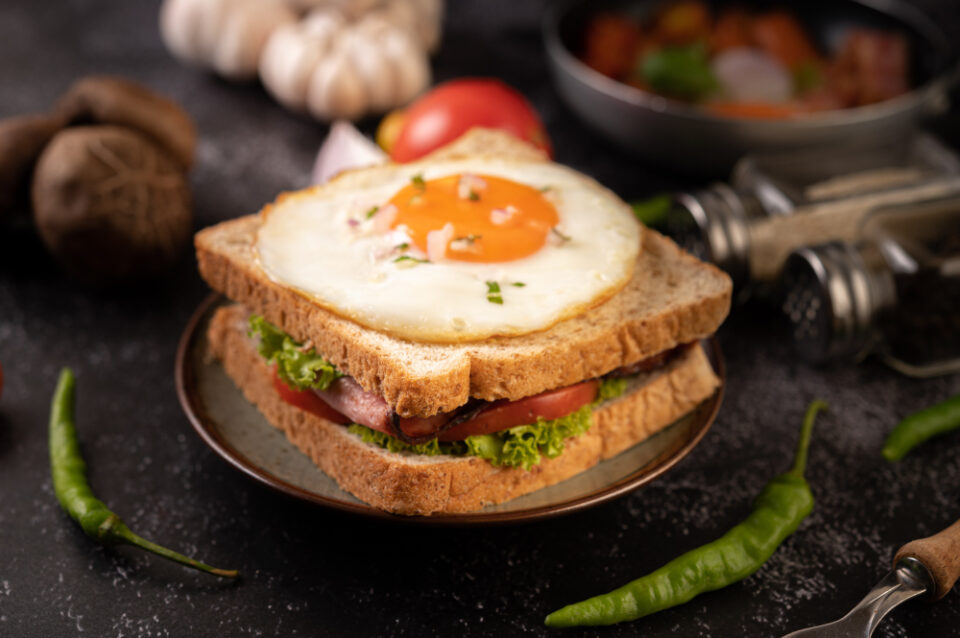
Some foods arrive with fanfare. Others just show up, do their job, and quietly take over the morning. Bread-omelette belongs to the second category. It did not descend from temple kitchens or Ayurvedic verses. It came with bakeries, colonial towns, railway lines, Irani cafés, and Goan and Parsi bakeries. Over the last century or so, bread simply moved from “foreign” to “normal,” one slice at a time. Ask anyone under forty when bread became Indian; they will look confused. For them, it always was.
Eggs made their own steady journey. Earlier generations remember backyard hens and Sunday omelettes. Today, most people buy eggs in trays from shops without asking which farm they came from. The source changed, the scale changed, but the omelette stayed. That’s the thing about breakfast: it doesn’t care about geopolitics; it cares about heat, salt, and timing.
As an Ayurvedic doctor in Bengaluru, I meet this combo every week in my OPD, not on the plate, but in the lab report and the confession. A patient settles in, smiles sheepishly, and says, “Doctor, I eat bread-omelette daily. It’s simple, quick, and tasty. Is it okay?” They ask it the way you’d ask if a long-time friendship is secretly bad for you—habit with a touch of guilt.
Let’s look at what’s actually on that plate.
Bread, especially the soft commercial loaves most people buy, is usually made from refined wheat flour (maida), water, yeast, salt, and often sugar and improvers to keep it soft and extend shelf-life. Refined flour digests quickly and raises blood sugar faster than whole grains. Research across nutrition journals has shown that diets high in refined grains are associated with a higher risk of weight gain and metabolic problems than diets rich in whole grains. That doesn’t mean one slice will harm you; it means a pattern matters more than a bite.
The egg, on the other hand, is nutritionally impressive. A single egg usually provides about 6–7 grams of high-quality protein, along with vitamins like B12, riboflavin, and fat-soluble vitamins, plus minerals like selenium. It also contains choline, which supports brain and liver function, and pigments like lutein and zeaxanthin, which support eye health. Extensive reviews now describe eggs as nutrient-dense foods that can fit into a healthy diet for most people, especially when they replace more processed meats. For many Indians, an egg is the most affordable “high-value protein” they will see in a day.
Ayurveda did not ignore eggs. Classical authors grouped them under foods of animal origin—heavier, richer, and more strengthening. Texts describe them as nourishing, tissue-building, and helpful in states of weakness or emaciation. At the same time, they are said to be “guru” (heavy) and “ushna” (heating), suitable for some bodies and circumstances, not for everyone, every day, in every season. The message was not “never eat.” It was “know when, know who, know how often.”
Now comes the fundamental question: what happens if you put bread and egg together every single morning?
In the short term, nothing dramatic. In fact, compared to skipping breakfast entirely or eating only sugary biscuits, bread-omelette will often leave you fuller and less likely to binge on snacks mid-morning. The protein in eggs can improve satiety; several studies have reported that higher-protein breakfasts help people feel full for longer and sometimes assist with weight management.
The concerns arise when the details go wrong: only refined bread, too much oil, always deep-fried, extra butter, sugary ketchup, no fibre, and absolutely no variety for months. That’s when people start describing familiar symptoms: acidity, heaviness, afternoon energy crashes, stubborn weight, borderline sugar, or cholesterol that creeps up without fanfare. Not because the food is “poison,” but because a single pattern, repeated blindly, slowly outgrows what the body can compensate for.
We now know that dietary diversity supports gut health. Different fibres and plant compounds feed different bacteria in the intestines. When the diet narrows, microbial diversity tends to shrink. While there’s no specific paper saying “same breakfast equals disease,” many studies agree that variety—especially in plant foods—is good for the microbiome and overall metabolic resilience. Ayurveda expressed the same truth in another language: rotate foods with the seasons and one’s condition, rather than clinging to one combination all year, every year.
Behind all this science lies the human story.
A middle-aged software engineer once told me, “Doctor, bread-omelette is my only stable relationship.” He left home early, returned late, and changed companies more often than Tupperware boxes. The one thing that did not change was the small hotel near his apartment that made his breakfast exactly the same way every morning. When I suggested some variety, he said, “I don’t want decisions at 8 a.m. I just want food.” Underneath the joke, I heard exhaustion.
Another patient, a retired teacher, said she felt uneasy if she didn’t have her bread-omelette. “It reminds me of the years I rushed to catch the bus to school,” she said. “It tastes like I still have somewhere to go.” For her, the omelette was not just protein; it was identity.
This is why I don’t tell people, “Stop eating bread-omelette.” That kind of advice sounds righteous and rarely works. Instead, I ask them to notice how they feel on days they have it, and on days they don’t. Notice the energy, digestion, mood, and cravings. The body keeps a more honest diary than the mind.
Many patients discover that they can keep their beloved breakfast, but they don’t need it daily. Three days a week with small upgrades—like using better-quality bread, controlling oil, adding a bit of salad or fruit, or pairing it with a handful of nuts—already shifts their reports and their experience. On other days, they rediscover older options: idli, dosa, poha, upma, ragi porridge, or even simple phulka and sabzi. Health doesn’t demand perfection; it appreciates rotation.
From an Ayurvedic lens, this is the heart of the matter. The question is not “Is bread-omelette good or bad?” The question is “For whom, how often, in what state of digestion, and with what balance in the rest of the day?” A young, active person with a strong appetite, mostly home-cooked meals, and good sleep will handle it very differently from a sedentary, stressed, irregular sleeper whose other meals are also refined and packaged.
In the clinic, I often tell patients, “No breakfast is automatically healthy if you eat it without thinking. And no breakfast is automatically harmful if you eat it with awareness and balance.” They laugh, but they remember.
The truth is, after reading all this, you may still feel like eating bread-omelette. That’s okay. My aim is not to snatch the plate from your hand. My aim is to place a small mirror next to it.
Because in the long run, what shapes your health is not one egg, one slice, or one morning.
It is the quiet, repeated answer to a simple question you rarely ask yourself at 8 a.m.
“Am I eating this because it serves my body today—
Or only because I forgot I have other choices?”
The tongue will always ask for taste.
Wisdom begins when the rest of you join the conversation.
I have written a book.
If this blog spoke to you, the book will stay with you longer.
