
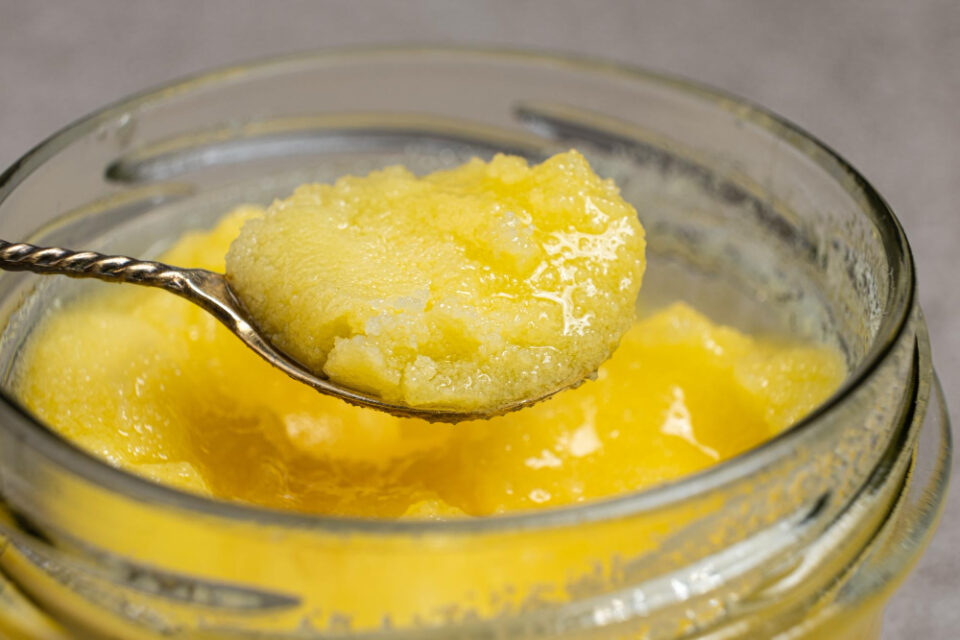
For years, ghee has been treated like a prime suspect at the health crime scene—blamed for cholesterol, judged for fat, and quietly exiled from urban kitchens while the real culprits walked free. One week it’s hailed as “liquid gold,” the next it’s vilified as a heart-clogging villain. In my clinic, patients often enter with two burning questions: “Doctor, is ghee bad for cholesterol?” and “Can I eat it if my triglycerides are high?” The mother-in-law says it’s sacred. The dietitian says to avoid it. The WhatsApp group says Add it to your coffee. So, what’s the real story?
Let’s begin at the dining table. Last week, a 42-year-old tech professional walked into my clinic. “Doctor,” he said, “I’ve stopped ghee completely, switched to olive oil, but my cholesterol still went up.” His eyes widened in disbelief as I scribbled on his prescription: “One teaspoon ghee daily — with love, not fear.”
The truth? Ghee is not your enemy. It’s misunderstood.
Ayurveda has praised ghrita for over 5,000 years — not just as a food, but also as a medicine. In our texts, it is referred to as Medhya (brain booster), Agnivardhak (digestion enhancer), and Rasayana (rejuvenator). We don’t just stir ghee into your khichdi; we stir it into herbs to help them reach deep into your tissues. And yes, we use it to cleanse, nourish, calm, and even boost cognition. No other fat is so deeply embedded in our cultural and therapeutic landscape.
But what does modern science say? Is it just Ayurveda’s emotional bias?
A landmark study from Ohio State University showed that in normal rats, ghee did not raise total cholesterol or triglycerides. When used at 2.5–10% of dietary fat, ghee lowered LDL (bad cholesterol), triglycerides, and markers of liver fat. Heated ghee didn’t fare badly either — unlike industrial oils, it didn’t increase lipid peroxidation (oxidative damage). In human studies, medicated ghee even helped psoriasis patients lower their lipids.
However, in genetically sensitive rats (specifically, the Fischer inbred rats), 10% ghee did raise triglycerides — a reminder that context matters. Ghee isn’t poison, but neither is it a free pass.
So, does ghee increase triglycerides?
Not in moderate amounts. Its conjugated linoleic acid (CLA), short-chain fatty acids, and good balance of Omega-3 and 6 have been shown to reduce inflammation, promote fat metabolism, and support HDL (the “good” cholesterol). Too little is medicine. Too much is mischief. Even ghee needs a limit.
Now let’s address the Indian kitchen elephant: Desi ghee vs. Cream ghee vs. Goghrita vs. A2 Ghee.
Traditional Ayurveda prefers curd-churned ghee from Indian desi cow’s milk — the kind your grandmother made by setting curd, churning butter, and slowly boiling it over a wood fire. This ghee, known as Goghrita, is rich in bioavailable vitamins, short-chain fatty acids like butyric acid (great for the gut), and has Yogavahi qualities — it carries herbs deeper without losing its virtue.
Modern A2 ghee is made from cows that carry the A2 beta-casein gene (native breeds such as Gir and Sahiwal). Some studies suggest that A2 milk is less inflammatory than A1, but the jury is still out. I often tell patients that what matters more is how the ghee is made and consumed, not just the cow’s genetic makeup.
Then there’s Navaneeta Ghrita—ghee prepared directly from churned white butter, bypassing the curd fermentation step. While it’s rich and fragrant, I’ve often observed in my practice that this type of ghee can feel heavy for individuals with weak digestion, especially those prone to Ama (undigested toxins), bloating, or sluggish metabolism. On the other hand, Ksheera Ghrita—ghee made by first fermenting milk into curd and then churning it into butter—is traditionally considered more samskara-yukta (properly processed) in Ayurveda. This method enhances its digestibility and therapeutic value. It is lighter, more sattvic, and better tolerated by children, the elderly, and those with Vata-Pitta imbalances. Curd-churned ghee wasn’t tradition for tradition’s sake—it was biology disguised as ritual.
Most ghee available in supermarkets today is mass-produced from cream, not curd—chosen for speed and profit, not for health. This cream-based ghee skips the natural fermentation step that enhances digestibility and medicinal value. Worse, many commercial ghees are adulterated with palm oil, vanaspati, or synthetic flavouring to mimic the aroma of real desi ghee. Labels may say “pure,” but purity in packaging doesn’t guarantee purity in preparation. If possible, make ghee at home from curd-churned butter—it’s slow, but it’s sacred. If that’s not feasible, choose trusted brands that specify “Bilona method” or “curd-churned” on their labels. In the world of ghee, shortcuts are common, but health has no shortcut.
Anecdotally, I’ve seen patients with high cholesterol normalise their lipids after switching from refined oils to moderate ghee use, especially when coupled with lifestyle tweaks, such as early dinners, walking, pranayama, and reducing the use of food delivery apps.
Is ghee beneficial for lowering cholesterol?
Yes, if you,
- Use the right kind: desi cow ghee, churned from curd and traditionally prepared.
- Use the right amount: 1–2 tsp a day, preferably with hot food, never cold.
- Use it correctly: don’t overheat it. Avoid deep-frying.
Avoid if,
- You’re gulping spoonfuls as part of a fad keto diet without understanding your body type.
- You have acute pancreatitis or very high triglycerides with fatty liver (seek personalised advice).
Why do some doctors fear ghee?
Because they were taught in the 1980s that all saturated fat is bad, that narrative is slowly shifting, but inertia lingers. Many Indian doctors still think of ghee the same way as vanaspati or butter, but they’re not the same at all. However, unlike vanaspati (rich in trans fats), ghee is rich in SCFAs, such as butyrate, which support colon health, gut lining, and immunity. It’s not the same villain.
Still, the key is moderation. As I tell my patients, “Ghee won’t fix an unhealthy diet, but it can make your dal healthier and tastier.”
One elderly gentleman from Jayanagar told me, “Doctor, I’ve had ghee all my life — I’m 84 now, and I don’t take any tablets—just sing my bhajans and enjoy my meals with ghee. His secret? Early meals, regular walks, daily prayers, no sugar, and one spoonful of ghee in hot rasam.
Maybe it’s not just what you eat, but how you live around your food.
Ghee is not a magic potion. However, it is sacred when consumed with intention, taken in moderation, and respected as part of a holistic approach to life. The West is just discovering it in “Bulletproof coffee” and “Ayurveda cleanses.” We’ve had it all along—gold on our plate while hunting for health on foreign shelves.
The fear of fat didn’t begin in kitchens—it started in boardrooms and bad science. In the 1950s, Ancel Keys’ flawed “Seven Countries Study” blamed saturated fat for heart disease, and the world listened. Supermarkets responded with “low-fat” everything. Butter was demonised. Ghee, by association, was quietly shunned—even in Indian homes where it once held sacred status.
What followed was a public health experiment gone wrong. Decades of low-fat diets coincided with rising obesity, type 2 diabetes, and heart disease. Nutritionist Nina Teicholz called it “the biggest health mistake of our time.” Dr. Mark Hyman often reminds us that “the real problem isn’t good fats like ghee—it’s sugar, refined carbs, and ultra-processed oils.”
Today, a quiet revolution is underway. Cardiologists like Dr. Aseem Malhotra, a former fat-avoider turned advocate for ghee, are rewriting the script. He now says that saturated fat from natural sources, like ghee, is not the enemy. Instead, chronic inflammation, metabolic syndrome, and industrial seed oils are the real culprits. Harvard now says what grandmothers knew all along—it’s not the fat, it’s where it comes from and how you treat it.
In Ayurveda, we never separated fat from function. Ghee was never just about taste—it was about intelligence, transport, and tissue nourishment. It was always about balance.
Ghee isn’t a trend. It’s a return.
Not all that melts is dangerous. Some things, like ghee, melt fear.
Don’t fear the ghee. Fear the fake facts.
